
The “VAM” Rabbit Hole: Advanced Morgan Dollar Collecting
For most people, completing a standard collection of Morgan Silver Dollars by date and mint mark is the achievement of a lifetime.
But for a dedicated subset of advanced numismatists, the date on the coin is just the beginning of a much deeper, microscopic obsession known as the “VAM” rabbit hole.
When you hold a Morgan Silver Dollar, you are holding a massive, 90% silver piece of the American Wild West. Millions of collectors love them for their history, their silver content, and their beautiful George T. Morgan design. However, if you look closely enough through a magnifying loupe, you will discover that no two Morgan Dollars are exactly alike. For advanced collectors, hunting down these microscopic differences is the ultimate thrill of the hobby.
What Exactly is a VAM?
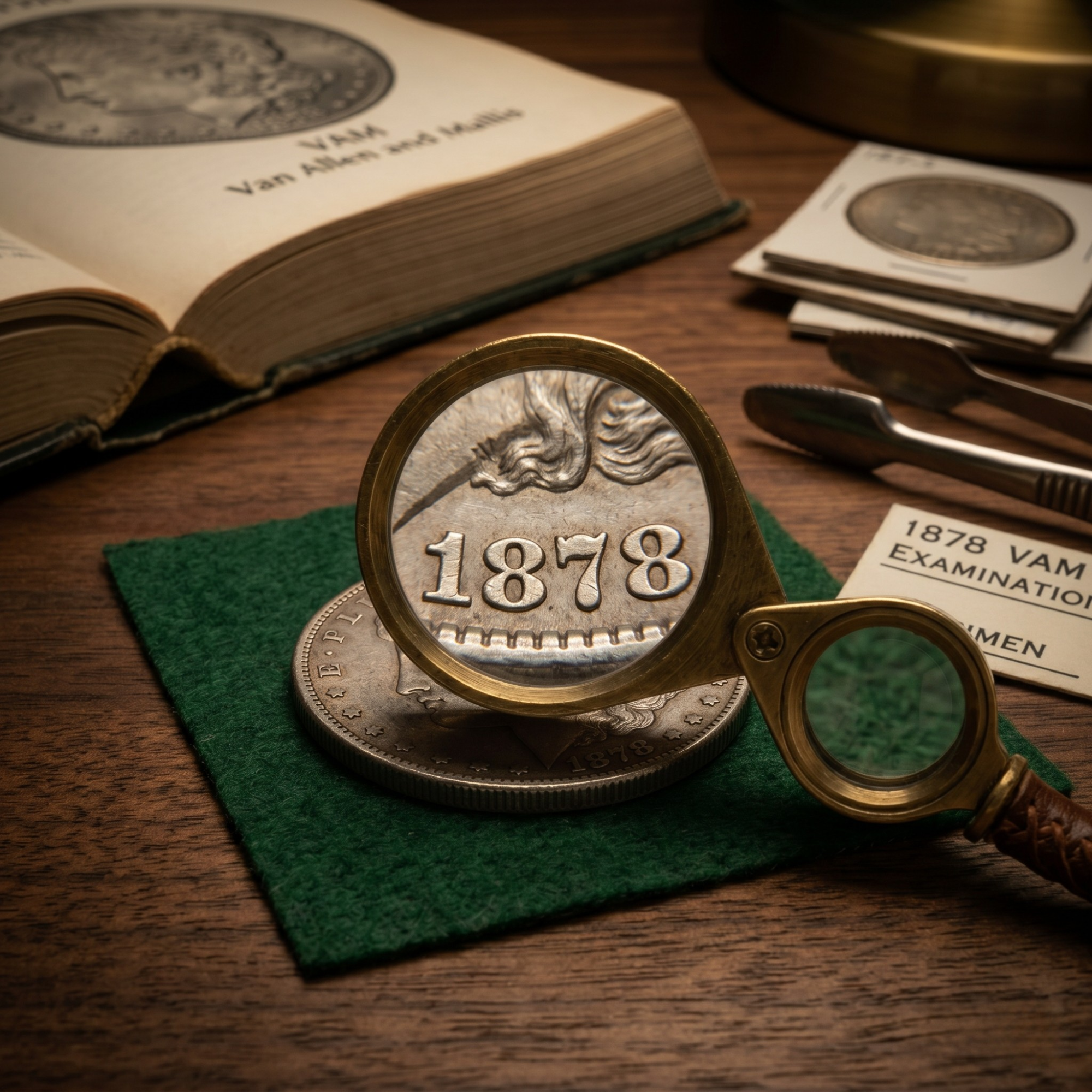
The term “VAM” sounds like a secret code, but it is actually an acronym derived from the last names of two legendary numismatic researchers: Leroy Van Allen and A. George Mallis.
In the 1970s, these two men published the Comprehensive Catalog and Encyclopedia of Morgan and Peace Dollars. They meticulously documented the microscopic differences between the hundreds of individual steel dies used by the United States Mint to strike these silver dollars. Today, a “VAM number” (such as VAM-3 or VAM-14A) is assigned to a coin to identify the exact, specific pair of dies that were used to strike it.
The Mechanics of a Mint Error
To understand VAMs, you have to understand how 19th-century coins were made. In the 1800s, the minting process was incredibly brutal on equipment. The massive mechanical presses slammed steel dies into silver planchets with immense force, hour after hour.
Under this punishing pressure, the steel dies would crack, chip, or shatter. Sometimes, a press operator would accidentally cycle the machine without a silver blank in the chamber, causing the top and bottom dies to violently smash into each other—leaving a ghosted imprint of the eagle on Liberty’s face (a “die clash”). Furthermore, mint marks and dates were often punched into the working dies by hand, meaning the letters could be slightly tilted, placed too high, or even punched twice (a “doubled die”). VAM collectors hunt for the specific coins produced by these damaged or uniquely altered dies.
Famous VAMs: Hot Lips and Spitting Eagles
With thousands of documented VAMs, the community has created lists like the “Top 100” and “Hot 50” to highlight the most dramatic and sought-after varieties. Some of these errors are so severe that they have earned legendary nicknames:
- The 1888-O “Hot Lips” (VAM-4): This is perhaps the most famous Morgan variety. The obverse die was heavily doubled, giving Lady Liberty two distinct noses, two chins, and a massive, doubled set of lips.
- The 1891-CC “Spitting Eagle” (VAM-3): A prominent die gouge appeared right near the eagle’s open beak on the reverse of this Carson City dollar, making it look exactly like the majestic bird is spitting.
- The 1878 8-Tailfeathers: In the very first year of production, the Mint realized the eagle on the back of the coin inaccurately had 8 tailfeathers instead of the anatomically correct 7. They changed the design mid-year, creating a massive web of early VAM varieties as the old dies were altered and over-stamped.
The Thrill of the Hunt and the Premium Payout
Why do people spend hours staring through a microscope at old silver dollars? The answer is the thrill of the “cherrypick.”
Because the differences are often microscopic, a rare VAM can easily slip past a general coin dealer or a novice collector. You might buy an entirely standard, common-date 1888-O Morgan Dollar out of a display case for $40. But if you get it home, put it under a loupe, and discover it is actually the rare “Hot Lips” VAM-4 variety, that $40 coin might suddenly be worth hundreds or even thousands of dollars to a specialized collector.
Falling Down the Rabbit Hole
VAM collecting is not for the faint of heart. It requires patience, a good magnifying loupe, and a willingness to learn the intricate geography of the Morgan Dollar design. But once you start looking for die cracks, clashing, and doubled dates, you will never look at a standard silver dollar the same way again.
Do You Have Rare Morgan Dollar Varieties?
If you have a collection of Morgan Silver Dollars, you might be sitting on unrecognized VAM varieties carrying massive premiums. Proper attribution requires a trained eye and extensive numismatic knowledge.
Contact Keywell Collectibles today for a professional appraisal and attribution of your vintage silver dollars.