

Michigan’s Forgotten Money: A Guide to Local “Obsolete Banknotes”
Long before the federal government printed standardized dollar bills, the money in a Michigander’s pocket looked wildly different depending on what town they were in.
During the “Free Banking Era” of the 1830s, hundreds of local banks across the state printed their own paper currency, creating a chaotic, beautiful, and highly collectible era of “Obsolete Banknotes.”
If you open your wallet today, every dollar bill looks exactly the same, backed by the full faith and credit of the United States government. But if you were living in Michigan right around the time it became a state in 1837, the financial landscape was the Wild West. There was no federal paper money. Instead, local banks, railroads, and even pharmacies printed their own unique paper bills.
Today, these “Obsolete Banknotes” or “Broken Bank Notes” are some of the most fascinating and historically rich items a numismatist can collect, especially for those with a passion for local Michigan history.
The Birth of the “Wildcat Bank”
In 1837, the newly formed state of Michigan passed the General Banking Law. This law allowed practically anyone to open a bank, as long as they had a certain amount of capital. Suddenly, banks sprouted up all over the state, and every single one of them started printing their own paper money.
However, paper money is only valuable if it can be redeemed for physical gold or silver. Many of these new bankers were outright scammers. To prevent people from cashing in their paper bills, they would intentionally build their banks in the deepest, most inaccessible parts of the Michigan wilderness. People joked that these banks were located in areas so remote that “only the wildcats roamed there.” This is exactly where the famous financial term “Wildcat Bank” comes from!
Beautiful Art, Worthless Paper
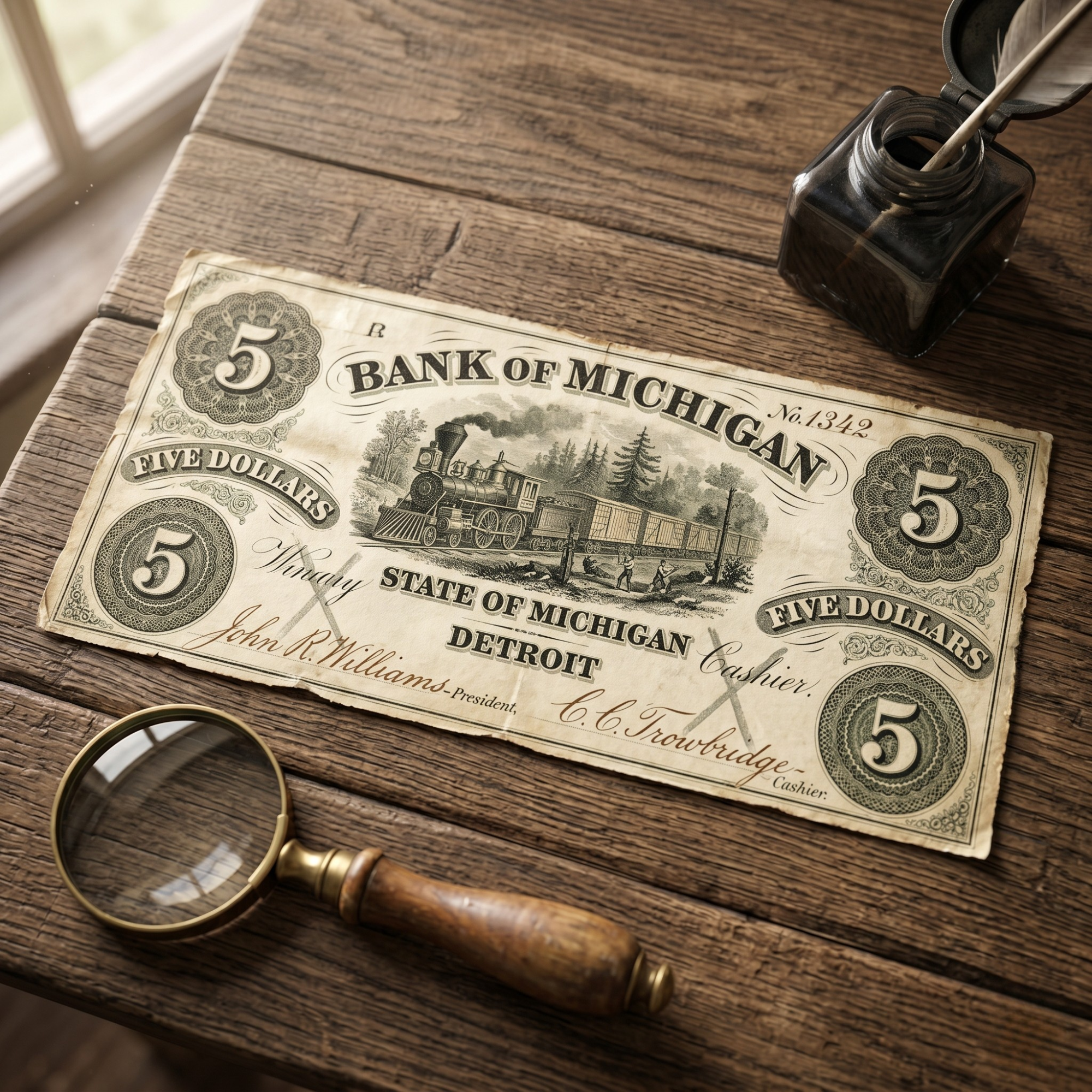
Because there was no standardized design, the artwork on Michigan obsolete banknotes is absolutely incredible. To convince the public that their money was legitimate, banks hired elite engraving companies to print their bills.
These notes feature stunning, intricate vignettes. You will find scenes of early Michigan life: lumberjacks cutting down pine trees, steam locomotives, Native American chiefs, farmers harvesting wheat, and majestic ships sailing the Great Lakes. Despite the beautiful artwork, the economic reality was disastrous. When the Financial Panic of 1837 hit, the vast majority of these wildcat banks collapsed overnight. The beautiful paper money they printed instantly became entirely worthless.
Collecting Michigan History
Because the federal government eventually stepped in and taxed local paper money out of existence during the Civil War, these obsolete notes are a closed chapter of history. For modern collectors, hunting down these bills is like putting together a localized puzzle of early America.
Collectors typically focus on a few key areas when buying obsolete currency:
- Towns and Cities: A collector in Ann Arbor might exclusively try to find notes from the historic “Bank of Washtenaw,” while someone in Detroit might hunt for notes from the early “Bank of Michigan.”
- Vignettes (Artwork): Some collectors ignore the town and focus entirely on the artwork, collecting notes that specifically feature dogs, eagles, or early trains.
- Signatures and Serial Numbers: These notes were signed by hand in actual ink by the bank’s president and cashier. Finding a note with a clear, legible signature from a prominent historical Michigan figure adds massive value.
Cut Cancellations and Counterfeits
When you find an obsolete banknote, you might notice huge “X” marks cut directly through the paper, or the signatures might be violently crossed out. This is known as a “cut cancellation.” When a bank went out of business or a note was successfully redeemed, the bankers would physically mutilate the bill so it could never be spent again. While intact, uncanceled notes are generally more valuable, canceled notes tell a fascinating story of the bill’s actual use in commerce.
Additionally, because there were thousands of different designs across the country, counterfeiting was rampant. “Bank Note Reporters” were published weekly just to help merchants figure out if the Michigan bill they were handed was real, fake, or from a bank that had already gone bust!
Did You Inherit Old Michigan Currency?
Because Keywell Collectibles is proudly headquartered right here in Michigan, we have a deep passion for local obsolete currency. If you have inherited large, beautifully engraved paper money from the 1800s featuring Michigan town names, you might be holding a rare piece of regional history.
Contact Keywell Collectibles today for a professional appraisal of your obsolete banknotes and vintage paper currency.