
Coins of the Bible: The Widow’s Mite and the Tribute Penny
For millennia, people have sought tangible, physical connections to the stories and figures of the Bible.
One of the most affordable and authentic ways to hold that history in your hands is through biblical numismatics—collecting the exact types of coins that circulated during the time of Jesus and the early Apostles.
Unlike ancient relics that are locked away in museums, the coins mentioned in the Old and New Testaments were minted by the millions to support the daily commerce of the ancient Near East. Because they were buried in hoards, lost in the dirt, and preserved for two thousand years, modern collectors can easily acquire these tiny pieces of ancient history. For religious scholars, history buffs, and coin collectors alike, holding a genuine biblical coin is a profound experience.
Here is the history behind two of the most famous coins mentioned in the New Testament.
The Widow’s Mite: A Lesson in True Wealth
Perhaps the most famous coin story in the Bible is the lesson of the Widow’s Mite (found in Mark 12:41-44 and Luke 21:1-4). Jesus is observing people donating money to the temple treasury. While the wealthy throw in large amounts of gold and silver, a poor widow comes forward and drops in two tiny copper coins. Jesus tells his disciples that she gave more than anyone else, because the wealthy gave out of their surplus, while she gave everything she had to live on.
But what exactly was a “mite”?
The word “mite” is actually a 14th-century Old English translation. In the original Greek text, the coins are called lepta (singular: lepton). A lepton was the smallest and lowest-denomination copper coin circulating in Judea at the time. It was worth a fraction of a cent.
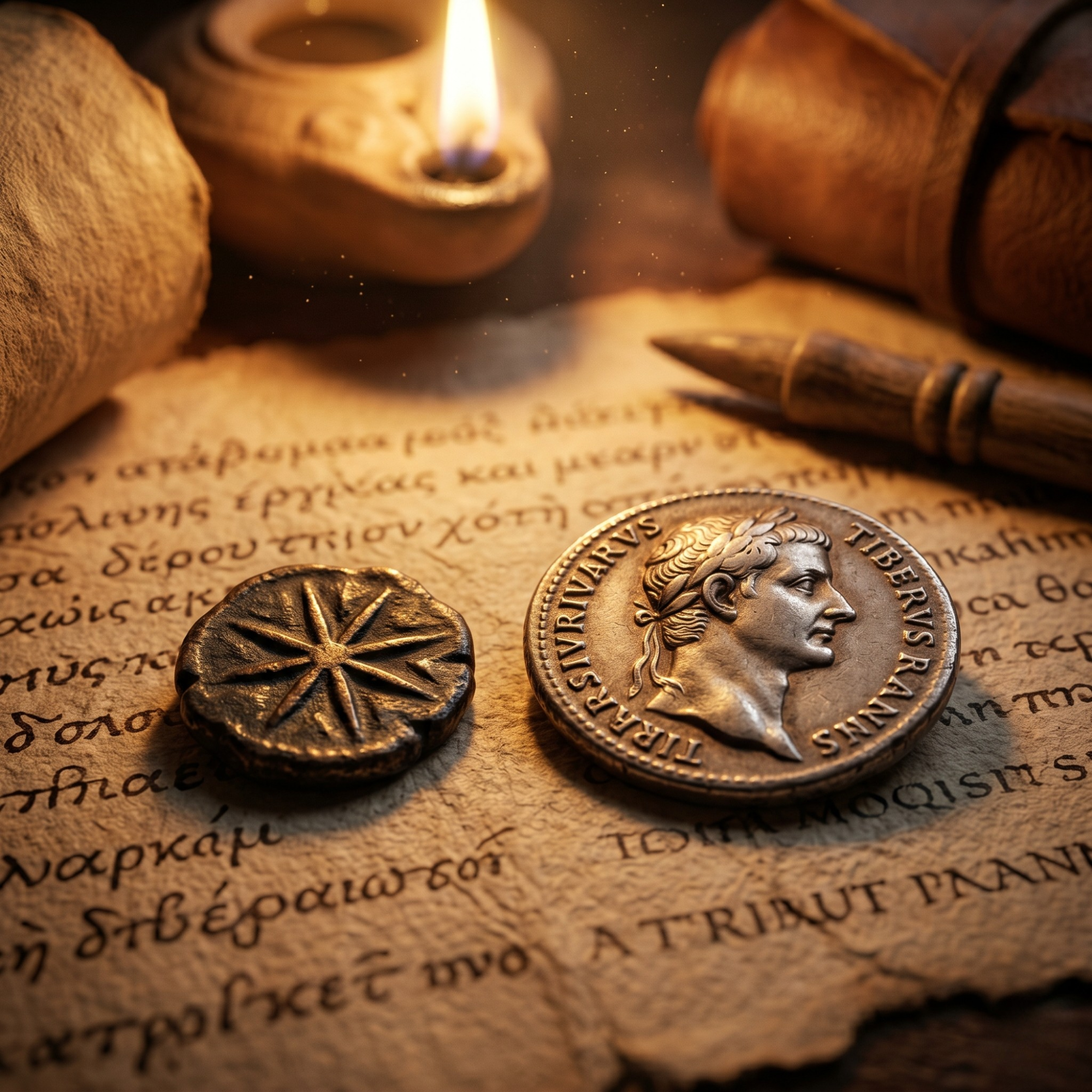
Today, numismatists identify the “Widow’s Mite” as the bronze prutah or lepton struck by the Hasmonean King Alexander Jannaeus (103–76 BC). These coins were minted in such massive quantities that they were still the standard small change used in Jerusalem decades later during the life of Jesus. They are notoriously crude, tiny, and irregularly shaped, usually featuring a simple anchor on one side and an eight-spoked star wheel on the other. Amazingly, because millions of them were made, you can easily purchase an authentic, 2,000-year-old Widow’s Mite today for under $50.
The Tribute Penny: Render Unto Caesar
Another iconic numismatic moment occurs when the Pharisees attempt to trap Jesus with a political question: “Is it lawful to pay taxes to Caesar, or not?” (Matthew 22:15-22).
Jesus asks them to show him the coin used for the tax. They hand him a Roman silver denarius. He asks whose image and inscription are on the coin. When they answer, “Caesar’s,” Jesus famously replies, “Render therefore unto Caesar the things which are Caesar’s; and unto God the things that are God’s.”
The coin handed to Jesus is known today by collectors as the “Tribute Penny.” Biblical scholars and numismatists widely agree that this coin was a silver denarius of Emperor Tiberius, who ruled Rome from 14 AD to 37 AD.
The obverse (front) of the coin features the right-facing profile of Tiberius, encircled by a Latin inscription translating to: “Tiberius Caesar, worshipful son of the divine Augustus.” The reverse (back) typically features a seated female figure holding a scepter and olive branch, believed to represent his mother Livia as Pax, the goddess of peace. Because of its direct connection to this famous biblical narrative, the Tiberius denarius commands a massive premium in the coin market compared to the denarii of other Roman emperors.
Thirty Pieces of Silver: The Price of Betrayal
While the Widow’s Mite and the Tribute Penny are the most collected, there is another deeply infamous coin in biblical history: the Thirty Pieces of Silver paid to Judas Iscariot for betraying Jesus.
While the Bible does not explicitly name the coin, historical context provides a very clear answer. The Jewish Temple required a specific annual tax, and the priests only accepted one specific coin due to its high silver purity: the Tyrian Shekel. Minted in the coastal city of Tyre, these large silver coins featured the Phoenician god Melqart (often associated with Hercules) on the front, and an eagle standing on a ship’s prow on the back. It is almost a historical certainty that Judas was paid out of the temple treasury using these exact Tyrian Shekels.
Building a Biblical Collection
Collecting coins of the Bible bridges the gap between theology and history. You aren’t just buying old metal; you are holding a primary document from the first century. However, because these coins carry such immense historical and emotional value, the market is heavily flooded with modern replicas and tourist fakes. You must buy ancient coins from highly reputable dealers who can guarantee their authenticity.
Want to Hold Ancient History?
Whether you are looking to purchase a genuine Widow’s Mite as a meaningful gift or want to acquire a certified Roman Tribute Penny for your collection, we can help you navigate the ancient coin market safely.
Contact Keywell Collectibles today to authenticate, appraise, or acquire genuine Biblical and Ancient Roman coins.