

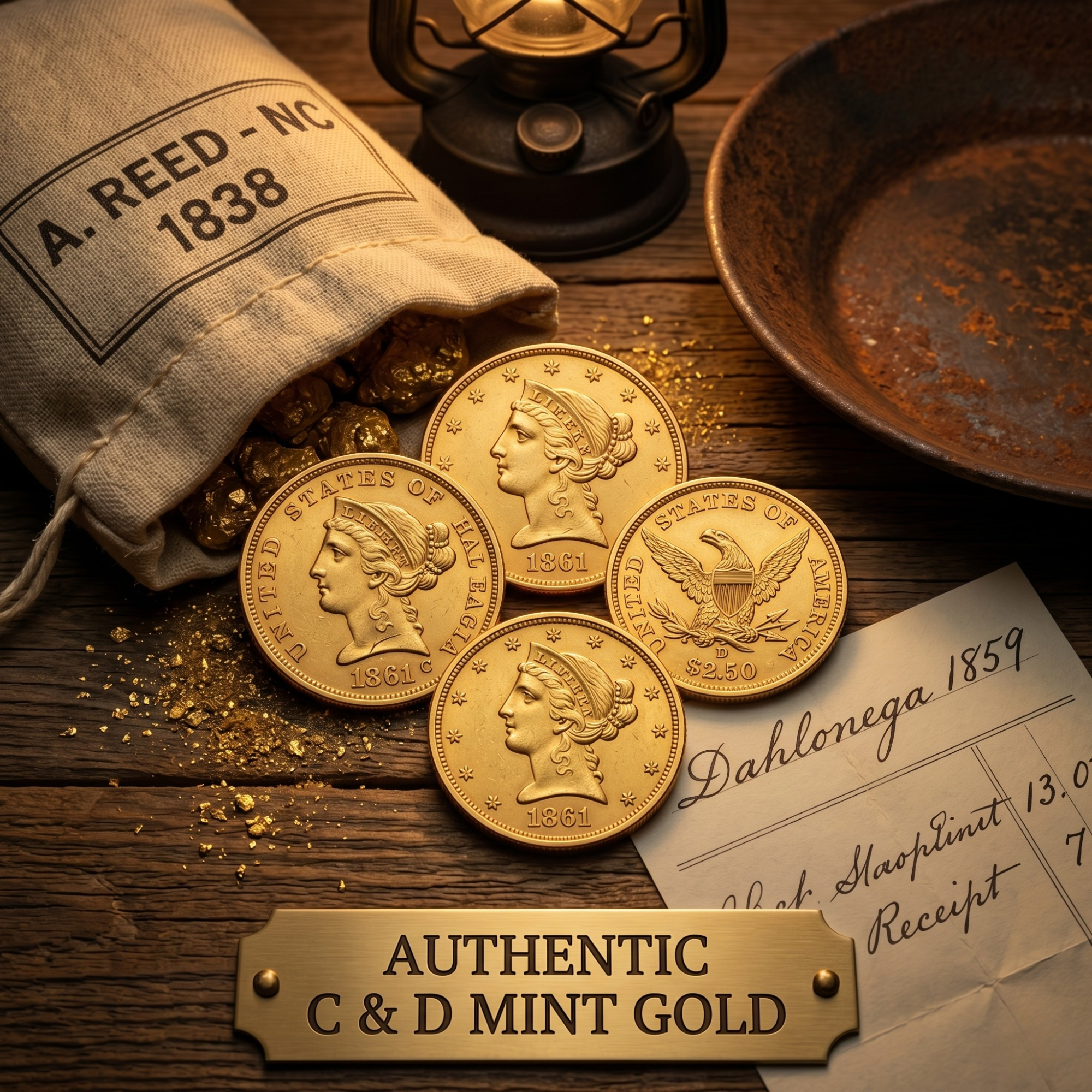
The Golden Secrets of the Deep South: The Charlotte and Dahlonega Mints
When most people think of the American Gold Rush, they immediately picture the rugged forty-niners panning for nuggets in the streams of California.
However, the nation’s true first gold rushes happened decades earlier on the opposite side of the country, giving birth to two of the most mysterious and highly collected mints in United States history.
If you look closely at the mint marks on modern coins, you expect to see a “P” for Philadelphia, a “D” for Denver, or an “S” for San Francisco. But for a brief, incredibly turbulent window before the American Civil War, the US Mint operated two remote branch facilities deep in the southern Appalachian Mountains. They were located in Charlotte, North Carolina, and Dahlonega, Georgia.
Coins bearing the “C” and “D” mint marks from this era are the stuff of numismatic legend. Here is the story of America’s forgotten southern mints and why collectors will pay massive premiums to acquire their gold.
The Original Gold Rushes
The story begins in 1799, when a young boy named Conrad Reed found a massive 17-pound yellow rock in a North Carolina creek. His family used it as a doorstop for three years before realizing it was solid gold. This sparked the first commercial gold mining boom in the United States. Thirty years later, in 1829, a second major gold strike occurred in the Cherokee territory of northern Georgia, triggering the Georgia Gold Rush.
Suddenly, the Deep South was flooded with raw gold. But there was a major logistical problem: the only operating United States Mint was in Philadelphia. Miners had to pack their gold dust and nuggets into wagons and send them on a long, dangerous journey through bandit-filled wilderness just to get it coined into legal tender. The miners demanded a local solution.
Enter the “C” and “D” Mint Marks
In 1835, Congress finally authorized the creation of branch mints in Charlotte and Dahlonega to process the localized gold directly at the source. Both mints officially opened for business in 1838.
These two southern mints were entirely unique in the history of the US coinage system for one specific reason: they exclusively minted gold. They never struck a single silver dime, copper penny, or nickel. If a coin came from Charlotte or Dahlonega, it was struck in pure Appalachian gold, typically in small denominations designed for local commerce like the $1, $2.50 (Quarter Eagle), and $5 (Half Eagle) pieces.
(Note: While Denver uses the “D” mint mark today, the Denver Mint did not open until 1906. If you see a “D” on a US gold coin dated between 1838 and 1861, it came from Dahlonega!)
The Outbreak of the Civil War
The lifespan of the Charlotte and Dahlonega mints was abruptly cut short by the outbreak of the American Civil War. In early 1861, as southern states began to secede from the Union, local Confederate forces marched on the mints and seized the facilities, the machinery, and the gold bullion inside.
The Confederates briefly continued to strike coins using the leftover United States dies, creating some of the most fascinating and heavily debated issues in numismatics (such as the 1861-D gold dollar). However, as the war progressed and raw materials dwindled, both mints were forced to shut their doors. The buildings were repurposed for the war effort, and neither facility ever struck a United States coin again.
Why Collectors Obsess Over Southern Gold
Today, Charlotte and Dahlonega gold coins are considered the ultimate prize for specialized collectors. There are several reasons why these specific pieces command such immense respect and value on the market:
- Tiny Mintages: These were small, frontier operations. While Philadelphia might strike hundreds of thousands of a specific coin, Dahlonega and Charlotte often struck just a few thousand pieces a year.
- Crude Characteristics: The southern mints suffered from broken presses, poorly prepared dies, and unskilled labor. Consequently, C and D mint coins are famous for their weak strikes, die cracks, and crude appearances. To a collector, these “flaws” are proof of their authentic frontier origins.
- Unique Coloration: The raw gold pulled from the Appalachian Mountains often contained high natural concentrations of silver and copper. Because the refining process was less exact than in Philadelphia, Charlotte and Dahlonega coins often have distinct greenish or deep orange-yellow tints.
- Low Survival Rates: Because these coins were used heavily in daily southern commerce, very few survived in pristine, uncirculated condition. Furthermore, many were melted down for their gold content during the financial hardships of the Civil War and the Reconstruction era.
A Rare Southern Legacy
Holding a gold coin from the Charlotte or Dahlonega mint is holding a ghost of the Antebellum South. They represent the rugged independence of America’s first gold miners and the tragic, sudden end brought about by a nation divided. Because of their absolute scarcity, encountering a genuine “C” or “D” mint gold piece in the wild is a major numismatic event.
Do You Have Vintage US Gold?
Evaluating pre-1861 United States gold requires an expert eye. The difference in value between a common Philadelphia strike and a rare southern branch mint strike can be tens of thousands of dollars, and counterfeits are incredibly common.
Contact Keywell Collectibles today for a professional, secure appraisal of your vintage gold coins and family heirlooms.