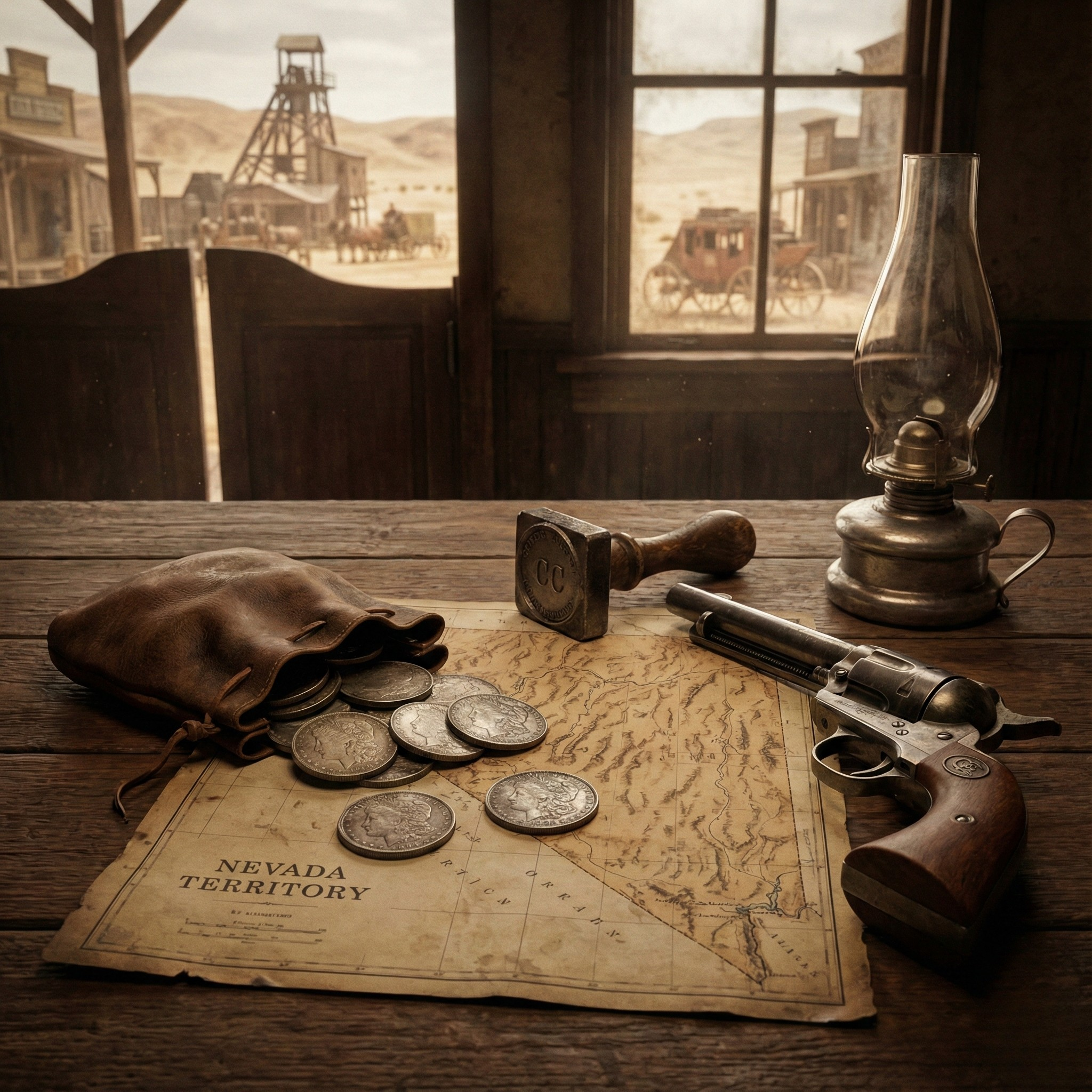
It was surrounded by saloons, gunslingers, and prospectors, born directly from the richest silver strike in US history.
This is the story of the Carson City Mint, and why the silver dollars that bear its mark are the most coveted icons of the Wild West.
Built on a Mountain of Silver
To understand the coin, you have to understand the ground it came from. In 1859, miners in Nevada (then the Utah Territory) discovered the Comstock Lode. It was a massive deposit of silver ore so rich that it essentially financed the Union Army during the Civil War and helped build San Francisco.
There was just one problem: Getting the raw ore from the Nevada desert to the mint in San Francisco was dangerous and expensive. The stagecoaches were slow, and the mountain passes were treacherous.
The solution was to bring the mint to the mine.
The Carson City Mint opened in 1870. Unlike the refined, granite institutions of the East Coast, the CC Mint was a rugged outpost. It was small, it was remote, and it existed for one primary purpose: to turn the Comstock’s silver into money.
The Allure of the “CC” Mint Mark
The Carson City Mint was short-lived. It minted coins only from 1870 to 1893. Because of this short operational window and the smaller population of the West at the time, the mintage numbers (the total number of coins produced) were incredibly low compared to Philadelphia or New Orleans.
For collectors, this creates a perfect storm of value:
- Scarcity: There simply aren’t that many of them.
- Romance: Holding a CC coin is holding a physical piece of the Wild West. These coins likely circulated in the pockets of cowboys, saloon keepers, and railway workers.
- The Brand: The “CC” mint mark, located on the reverse of the coin under the eagle’s tail feathers, is the only US mint mark composed of two letters. It stands out.
While the mint produced gold coins and smaller silver denominations, the undisputed king of the series is the Morgan Silver Dollar.
The Carson City Morgan Dollar (1878–1893)
If you are looking to build a serious investment portfolio of US coins, the Carson City Morgan Dollar is a blue-chip staple.
The series runs from 1878 to 1893. While any CC Morgan is valuable, there are tiers of rarity that every collector should know.
- The Common Dates: Years like 1882-CC, 1883-CC, and 1884-CC were produced in higher numbers (relatively speaking). These are the most accessible entry points for new collectors, often costing a few hundred dollars in uncirculated condition.
- The Key Dates: The 1889-CC is the crown jewel of the standard series. With a mintage of only 350,000 and a very low survival rate, this coin can easily fetch tens of thousands of dollars in high grades.
- The 1893-CC: The final year of production. The Panic of 1893 caused silver prices to crash, and the mint ceased coin operations shortly after.
The Miracle of the GSA Hoard
The story of the Carson City Mint has a twist ending that occurred nearly a century after the mint closed.
In the 1960s, the US Treasury did an audit of its vaults. Buried deep in the storage rooms, they discovered bag after bag of uncirculated silver dollars that had never been released to the public. To the shock of the numismatic world, nearly three million of these were Carson City Morgans.
In the 1970s, the General Services Administration (GSA) sold these coins to the public in a series of mail-order auctions. They packaged each coin in a distinctive, hard black plastic case with a certificate of authenticity.
A Critical Warning for Collectors:
If you own (or buy) a Carson City dollar in the original black GSA plastic holder, do not crack it open.
In almost every other area of coin collecting, we prefer coins in modern grading slabs (like PCGS or NGC). But for CC Morgans, the original GSA box is part of the history. It proves the coin sat in a government vault for a hundred years. Most major grading services can now grade the coin through the plastic or wrap a band around the GSA holder, preserving the original packaging. Breaking the coin out of the GSA holder can immediately lower its resale value.
Collecting the Legend
Collecting Carson City coins is not just about filling a hole in an album. It is about preserving the heritage of the American frontier. The mint building itself still stands today as the Nevada State Museum, a testament to the era when money was hard, heavy, and dug out of the earth by hand.
Whether you are looking for a single 1878-CC to display on your desk or hunting for the elusive 1889-CC, you are buying into the legend of the Comstock Lode.
Do You Have the “CC” Mark?
Because Carson City coins are so valuable, they are frequently targeted by counterfeiters. If you have a silver dollar with the “CC” mark on the back—especially if it is raw (ungraded)—you need to verify its authenticity before you sell or insure it.