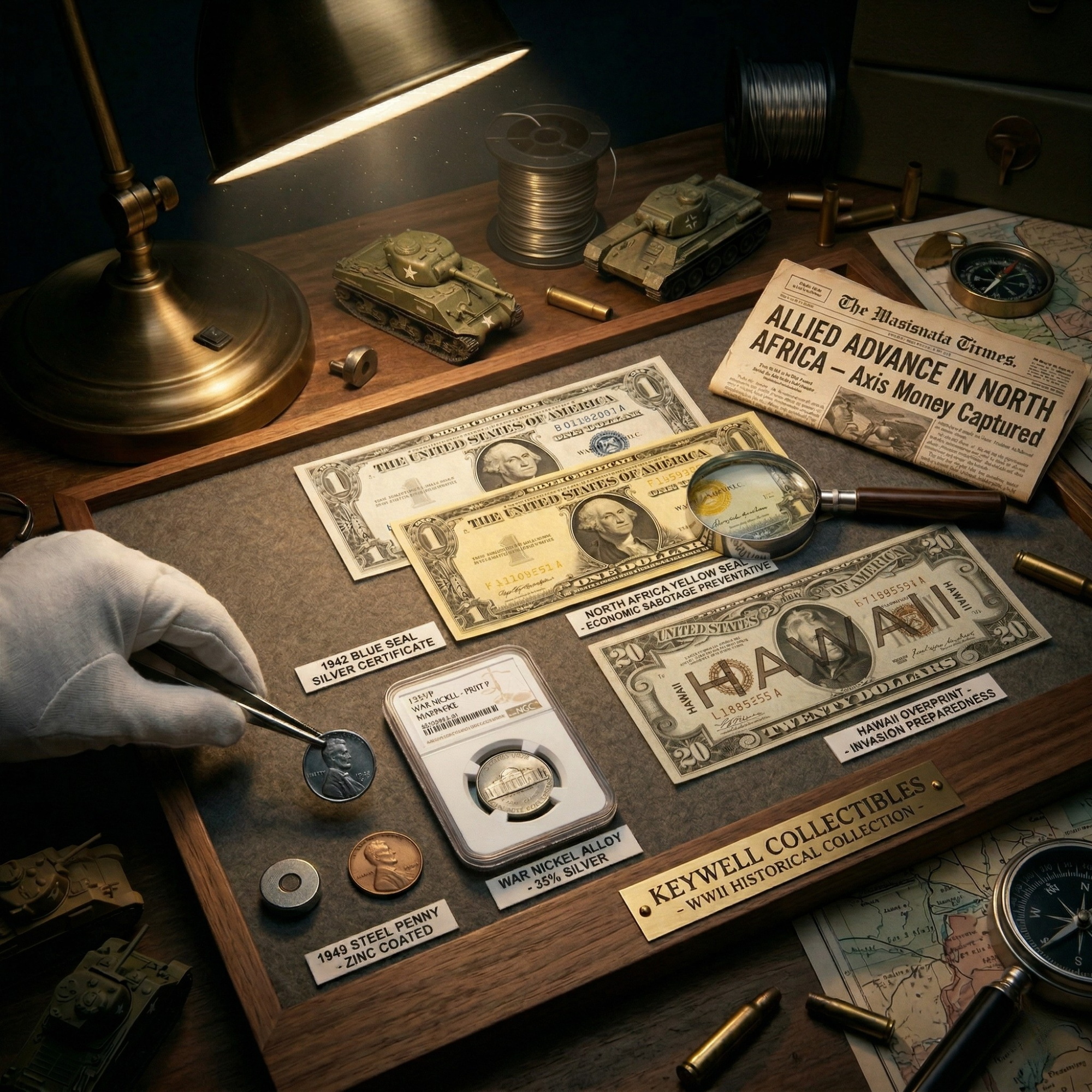
When we think of World War II history, we usually picture tanks, aircraft carriers, and rationing books. However, some of the most fascinating artifacts of the era are the coins and paper bills that ordinary citizens used to buy a loaf of bread. The US government was forced to make drastic, unprecedented changes to its currency to support the war effort—and these changes created some of the most highly collected numismatic items in history.
The 1943 Steel Penny: Copper for the Frontlines
As the United States ramped up production of ammunition, communication wires, and military equipment, copper became one of the most critical strategic materials on the planet. The US Mint realized it could not afford to waste thousands of tons of copper making pennies.
In 1943, the Mint completely halted copper penny production. Instead, they struck pennies out of steel coated with a thin layer of zinc. These “Silver Pennies,” as the public called them, were highly magnetic and quickly rusted as the zinc coating wore off in circulation. Today, they remain a fascinating one-year anomaly. (Note: This switch also inadvertently created the legendary 1943 Copper Penny error, struck on leftover bronze planchets from the previous year, which is now one of the most valuable error coins in the world!)
The Silver “War Nickel”: Nickel for Armor
Copper wasn’t the only metal the military desperately needed. Nickel was vital for creating heavy armor plating for tanks and battleships. To save this crucial resource, Congress authorized a temporary change to the five-cent piece from late 1942 through 1945.
The new “War Nickels” contained absolutely zero nickel. Instead, they were struck from an unusual alloy of 56% copper, 9% manganese, and 35% silver. Because the government wanted to eventually pull these silver coins out of circulation after the war ended, they needed a way to easily identify them. They placed a massive mint mark (P, D, or S) directly above the dome of Monticello on the reverse of the coin. This marked the first time the letter “P” (for Philadelphia) ever appeared on a US coin!
Hawaii Overprint Notes: Preparing for Invasion
The war didn’t just affect metal coins; it fundamentally changed paper money due to the threat of enemy invasion. After the devastating attack on Pearl Harbor, the US government feared that Imperial Japanese forces might launch a full-scale invasion of the Hawaiian Islands. If Japan captured Hawaii, they would seize millions of dollars in US currency, which they could then use to fund their own war machine.
To prevent this, the government recalled all regular money in Hawaii. In its place, they issued special currency with a brown seal and the word “HAWAII” overprinted in huge letters across the back. The strategy was brilliant: if Japan captured the islands, the US government would simply declare all “Hawaii” notes completely worthless, instantly destroying the enemy’s stolen wealth.
North Africa “Yellow Seal” Notes: Funding the Allied Advance
A similar strategy was used for American troops fighting in North Africa and Europe. Soldiers were paid with special Silver Certificates featuring a bright yellow treasury seal instead of the standard blue one. Just like the Hawaii notes, if a massive cache of this money was captured by German or Italian forces, the US could instantly demonetize the yellow seal notes, rendering them useless to the Axis powers.
A Tangible Piece of the Greatest Generation
Collecting World War II currency is one of the most affordable and historically rich areas of the hobby. For just a few dollars, you can hold a steel penny that helped build a bullet, a silver nickel that helped armor a tank, or a Hawaii note printed under the shadow of a global conflict. They aren’t just coins; they are physical reminders of a nation’s ultimate sacrifice.
Do You Have World War II Money in Your Collection?
If you have inherited a collection filled with “silver-looking” pennies, nickels with giant letters on the back, or paper money with strange colored seals, you are holding World War II history.
Contact Keywell Collectibles today for a professional appraisal of your historical currency.