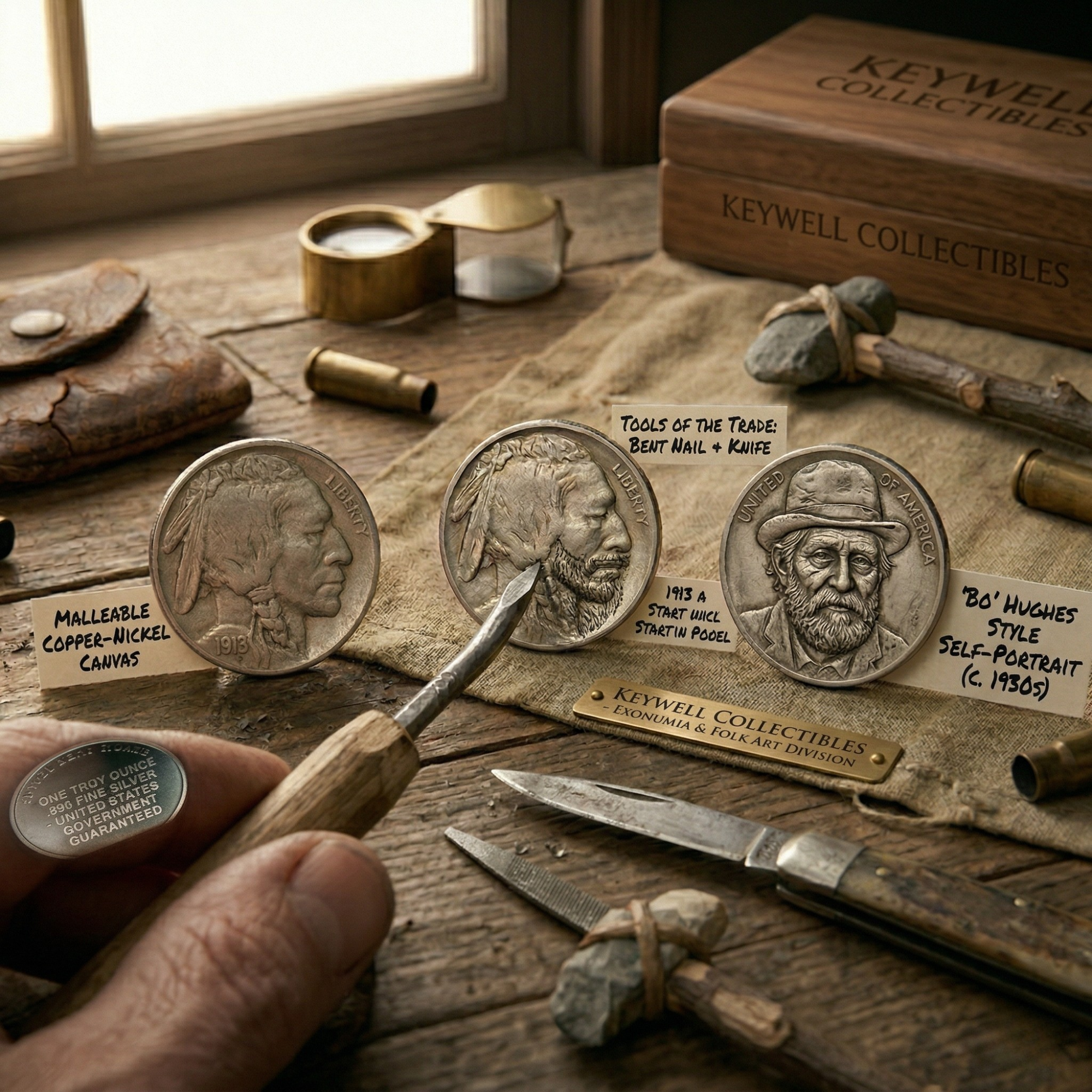
In the 1910s through the 1930s, the United States saw a massive rise in transient workers—hobos—riding the rails in search of employment. With plenty of time and very little money, some of these wanderers discovered they could take a standard five-cent piece, carve a new design into it, and trade their miniature artwork for a hot meal, a drink, or a warm place to sleep.
The Perfect Canvas: Why the Buffalo Nickel?
While artists had been altering coins for centuries (a practice often referred to as making “love tokens”), the Hobo Nickel phenomenon exploded specifically thanks to the release of the Buffalo Nickel in 1913.
James Earle Fraser’s iconic design featured a massive, high-relief portrait of a Native American that took up almost the entire front of the coin. This thick, broad profile provided a vast canvas of malleable copper-nickel. Carvers quickly realized they could use the existing raised metal to their advantage—altering the nose, carving a thick beard over the cheek, or turning the feathers into a bowler hat—without having to shave the entire coin flat to start over.
The Masters of the Rails
While thousands of nickels were carved by amateurs simply passing the time, a few men elevated the practice to true high art. Two of the most famous classic carvers were Bertram Wiegand (known to collectors as “Bert”) and his protege George Washington Hughes (known as “Bo”).
Bo Hughes, who lived as a hobo for decades, is considered the absolute master of the craft. He created thousands of nickels over his lifetime, often carving self-portraits, friends, or classic hobo stereotypes like clowns and bearded men with derby hats. Today, authentic original carvings by Bo or Bert are highly prized museum-quality pieces that can sell for thousands of dollars at auction.
The Tools of the Trade
What makes classic Hobo Nickels so incredible is the crude nature of the tools used to make them. These transient artists did not have access to modern Dremels, microscopes, or pneumatic engravers. They used whatever they could find, steal, or fashion themselves.
A standard toolkit might consist of a pocket knife, a bent nail, a small file, and perhaps a makeshift hammer. The fact that they could create delicate shading, complex textures, and distinct facial expressions with such primitive tools while sitting beside a railroad track is a testament to their immense, raw talent.
The Modern Revival
The art of carving coins didn’t die when the Great Depression ended; in fact, it is experiencing a massive modern renaissance.
Today, highly skilled engravers use modern optics and pneumatic tools to carve mind-blowing 3D skulls, pop culture icons, and intricate mechanical designs into nickels, silver dollars, and even gold coins. While these modern pieces are spectacular and highly collectible in their own right, purists still hunt for original “classic” hobo nickels from the early 20th century. Organizations like the Original Hobo Nickel Society (OHNS) actively help to authenticate, catalog, and preserve this unique piece of Americana.
Do You Have a Carved Coin?
Did you inherit a jar of old nickels and find one with a strange face carved into it? You might not have a damaged coin; you might be holding a rare piece of American folk art.
Contact Keywell Collectibles today for a professional appraisal of your vintage coins and exonumia.