

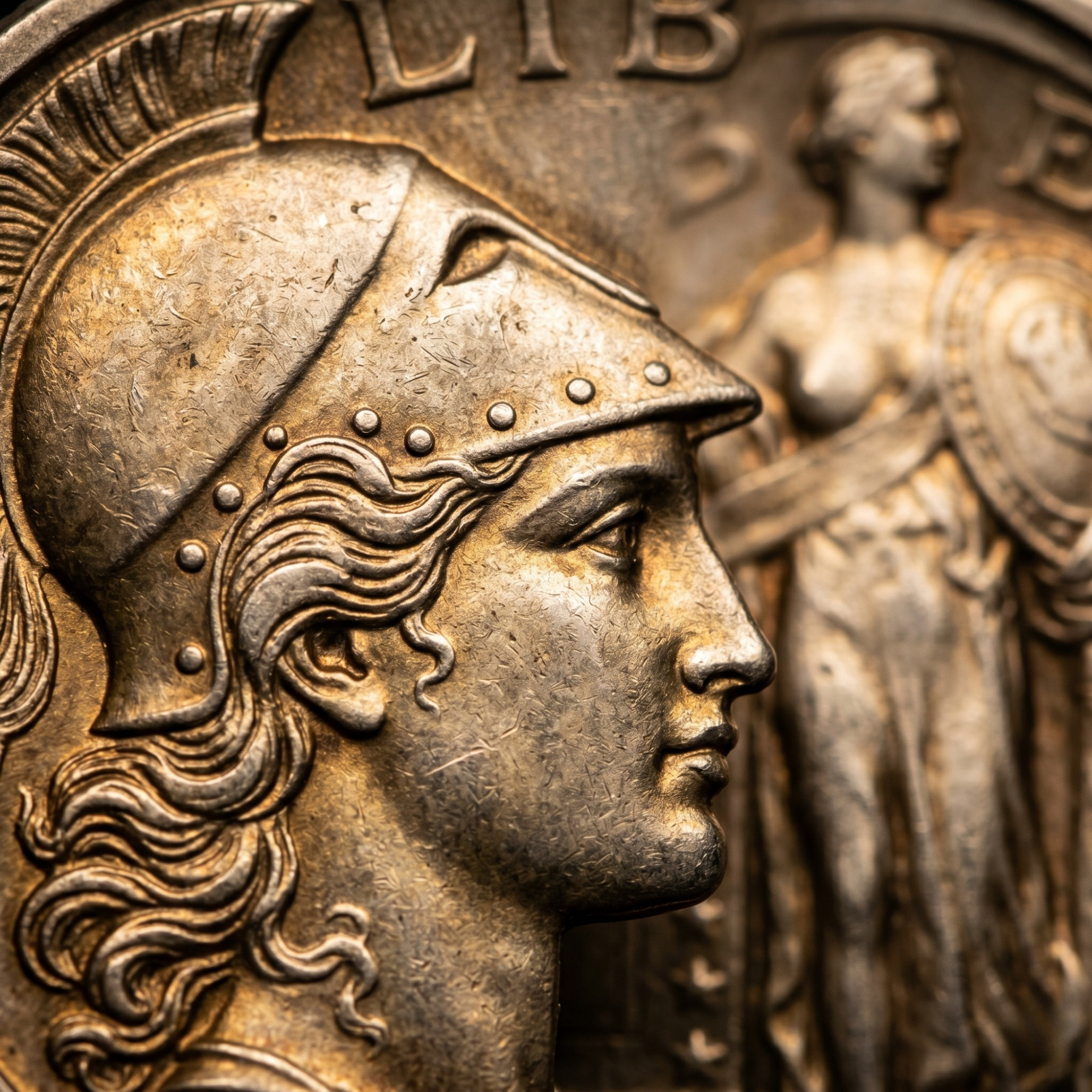
Standing Liberty Quarters: Controversy and Glory
You are looking at what many numismatists consider the most beautiful silver quarter dollar the United States has ever produced.
Struck from 1916 to 1930, the Standing Liberty Quarter is a masterpiece of dynamic, symbolic art that captures the exact moment America transitioned from isolationism to a global superpower.
It replaced the stoic, rather static “Barber” design that had dominated American coinage for two decades. The government wanted a coin that felt alive, relevant, and bold. What they got was a stunning design that was so artistically advanced for its time it caused an immediate public scandal and required two major redesigns. Today, the Standing Liberty series is the ultimate challenge for specialized collectors.
The Artistic Renaissance of 1916
The Standing Liberty Quarter was born during the “Renaissance of American Coinage,” a monumental beautification effort spearheaded by President Theodore Roosevelt and continuing under President Woodrow Wilson. In 1916, the US Mint decided to simultaneously update the dime, quarter, and half dollar, bringing in outside sculptors to create new, modern designs. The quarter commission fell to Hermon Atkins MacNeil, and his winning entry was a radical departure from the formal portraits of previous coins.
MacNeil’s design features a full-length figure of Lady Liberty standing in a gateway, not just a portrait. She is depicted looking toward her right (the East) toward the raging conflict of World War I. She holds an olive branch of peace, but she also holds a massive shield with an eagle and 13 stars, ready for defense. On the reverse, an eagle is shown in majestic, powerful flight. It was a beautiful, patriotic, and forward-looking design that perfectly captured the spirit of a free nation.
A Scandal in Silver: The Type 1 Design
When the coins hit circulation in late 1916, the public didn’t notice the patriotism; they noticed that Lady Liberty was missing part of her uniform. Following classical Greek and French artistic traditions, MacNeil had designed Liberty with her right breast exposed.
In the conservative social climate of 1916, this caused an immediate uproar. Religious groups and conservative politicians demanded the coin be withdrawn. The pressure was so intense that the US Mint was forced to completely redesign the coin mid-issue. Starting in 1917, the Mint released the “Type 2” design, which added a coat of mail covering Liberty’s chest. For collectors, this created the highly sought-after 1916 and 1917 Type 1 (Bare Breast) coins, which command a premium due to their scandalous one-year history.
The Second Problem: The Vanishing Date
The controversy surrounding Liberty’s uniform wasn’t the coin’s only issue. The design had a fatal technical flaw: the date was placed on the highest point of the design. This meant that the date was the very first thing to wear off when the coins were used. Dateless Standing Liberty quarters are extremely common, and because numismatic value is tied directly to the date, these coins are usually sold only for their 90% silver “melt” value.
In 1925, after nearly a decade of wear issues, the Mint redesigned the coin one final time. They “recessed” the date inside a protected groove, ensuring it would last the life of the coin. Every Standing Liberty Quarter minted between 1925 and the end of the series in 1930 will almost always have a readable date, even in heavily worn condition.
Key Dates and “Full Head” Kings
For the serious numismatist, the Standing Liberty series holds some of the most exciting key dates and conditional challenges in American history:
- The 1916: This is the undisputed “King” of the series. Because the bare-breast Type 1 design was only minted for a few short weeks in late 1916, only 52,000 were struck. Finding one in any condition is a major numismatic event, and high-grade examples can command staggering prices.
- The 1918-S over 17: A legendary error coin where the “8” was stamped directly over the “7” in the die, creating a prominent and valuable overdate variety.
- The “Full Head” (FH): The details on Liberty’s head, including her hair curls and the rivets on her helmet, are notoriously weakly struck. Grading companies will award the “Full Head” designation only to coins with crisp, complete facial and head details. Finding an FH coin is the ultimate condition rarity challenge for collectors.
Do You Have Vintage Standing Liberty Quarters?
Because of the date wear and the Type 1 vs. Type 2 distinctions, properly evaluating Standing Liberty Quarters requires specialized expertise. You need to know if your dateless quarter might be a valuable Type 1 or if your 1918-S is the rare overdate.
Contact Keywell Collectibles today for a professional, secure appraisal of your vintage silver coins and estate hoards.