

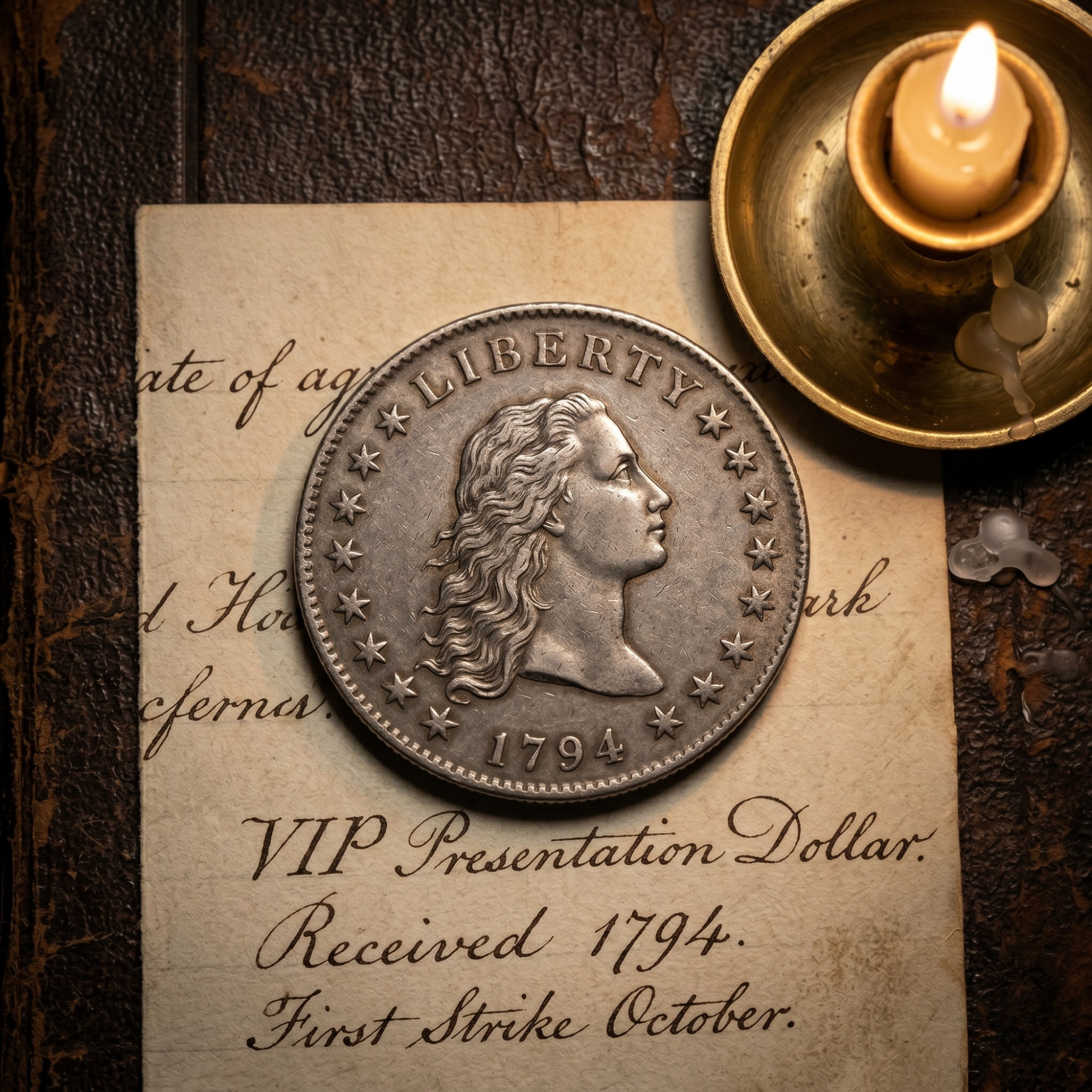
The First American Dollar: The Legend of the 1794 Flowing Hair
The birth of the United States dollar didn’t happen overnight; it was forged in the fiery, chaotic early days of a brand-new nation struggling to establish its financial independence.
At the center of this monumental effort was the 1794 Flowing Hair Silver Dollar, a crude but beautiful coin that stands today as one of the most valuable and historically significant pieces of metal in the world.
Before the United States had its own currency, early Americans relied on a confusing, international hodgepodge of money. Spanish Reales (Pieces of Eight), English shillings, and localized colonial copper coins all circulated simultaneously. To be taken seriously as a sovereign nation on the global stage, the United States needed a standardized, respectable currency backed by its own government. The Coinage Act of 1792 laid the groundwork, but making a physical silver dollar proved to be an incredibly difficult task.
A Mint in its Infancy
In 1794, the first United States Mint in Philadelphia was nothing like the high-tech, massive industrial facilities we have today. It was a modest, struggling operation powered by men and horses.
The biggest challenge was the equipment. To strike a large silver dollar, you need immense mechanical pressure. The Philadelphia Mint’s largest screw press—a massive machine operated by several men pulling weighted levers—was barely strong enough to properly stamp a coin of that size. The Mint director and workers knew the press was underpowered, but the political pressure to produce a tangible silver dollar was immense.
The Flowing Hair Design
The task of designing the nation’s new flagship coin fell to Chief Engraver Robert Scot. On the obverse (front), he designed a portrait of Lady Liberty with her hair blowing wildly in the wind, symbolizing a free and unconstrained young nation. She was surrounded by 15 stars, representing the 15 states in the Union at the time.
On the reverse (back), Scot placed an eagle surrounded by a simple wreath. The design received mixed reviews from the public—some critics thought the eagle looked a bit scrawny, and others felt Liberty’s wild hair looked unrefined—but it successfully established an icon that was distinctly American.
The Strike of October 1794
On a single day in October 1794, the Mint finally struck its very first batch of silver dollars. Because the hand-turned screw press was so underpowered, the striking process was extremely uneven. Many of the coins were weakly struck on one side, meaning the details of Liberty’s face or the eagle’s feathers didn’t fully transfer from the metal die to the silver planchet.
By the end of the day, the Mint had produced exactly 1,758 silver dollars.
Because the quality was so inconsistent, these coins were not released into general circulation to be spent at the local market. Instead, Mint Director David Rittenhouse distributed them as VIP presentation pieces. They were handed out to senators, congressmen, and foreign dignitaries as physical proof that the United States experiment was working and that the nation could mint its own sovereign wealth.
The $10 Million Dollar Coin
Fast forward over two centuries later, and the 1794 Flowing Hair Dollar is the holy grail of American numismatics. Out of the original 1,758 struck, experts estimate that only about 130 to 150 exist today.
Because of their immense historical significance and extreme rarity, they command staggering prices. In 2013, a spectacularly preserved “Specimen” 1794 Flowing Hair Dollar—believed by many researchers to be the absolute very first silver dollar ever struck by the US Mint—sold at auction for an astronomical $10,016,875. It set a world record, proving that early American history is highly prized by elite collectors.
A Tangible Piece of the Founding Era
Most collectors will never have the opportunity to own a 1794 Flowing Hair Dollar, and the design was quickly replaced in 1795 by the Draped Bust dollar. However, understanding its story is essential for anyone interested in coins or history. It is the physical manifestation of the US Constitution’s mandate to coin money, representing the exact moment America stood on its own two financial feet.
Do You Have Early American Silver?
While a 1794 dollar is a museum-level rarity, early American silver coins from the 1800s can still be found in inherited collections and estate hoards. Identifying early Bust dollars, half dollars, and quarters requires a specialized understanding of die varieties and early minting techniques.
Contact Keywell Collectibles today for a professional, secure appraisal of your early American coins and vintage currency.