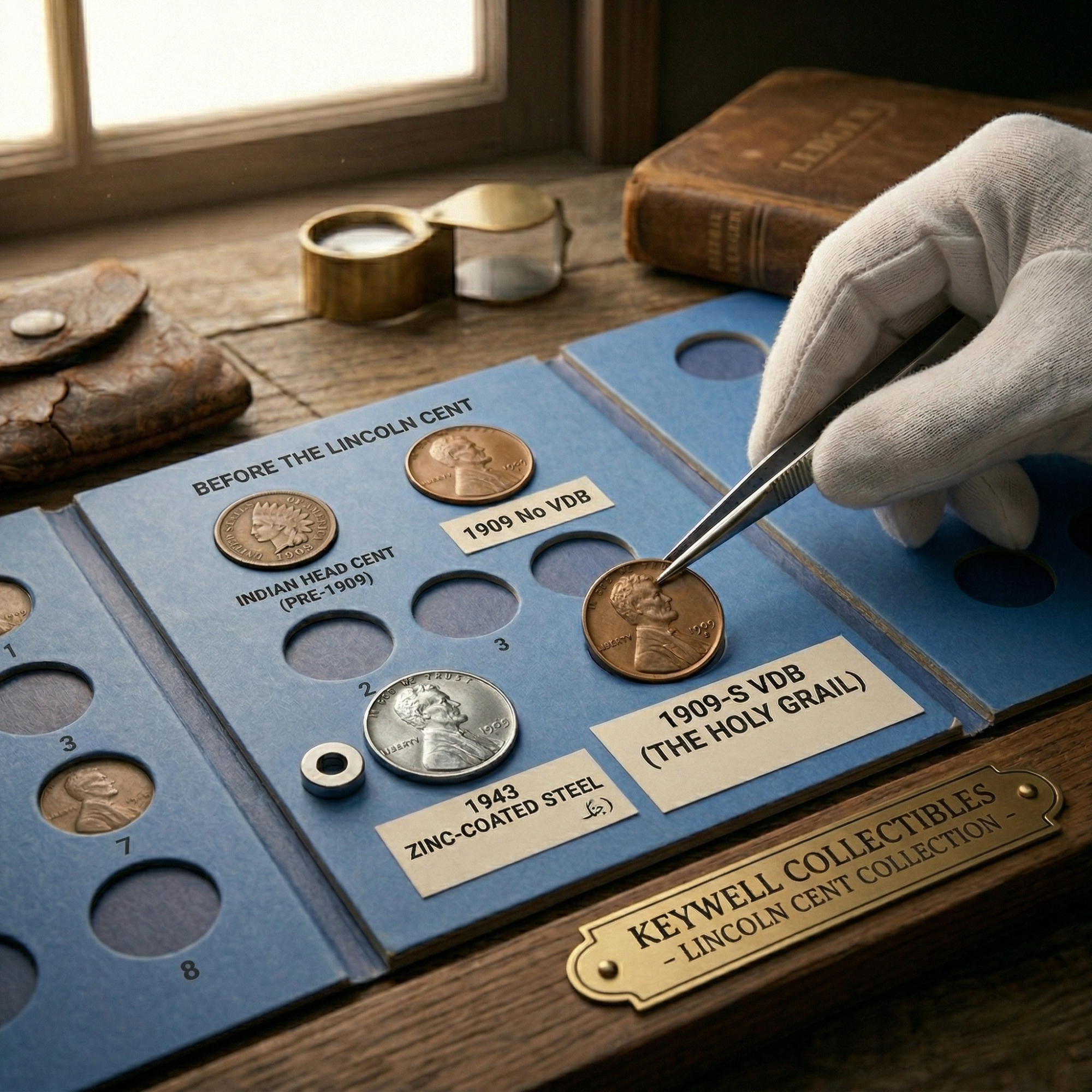
Because it is worth so little in everyday commerce, the penny is often ignored. People literally throw them away or leave them in the “Take a Penny” tray at the gas station. But in the numismatic world, the Lincoln Cent is royalty. It is the gateway drug to coin collecting. Almost every serious collector started their journey by pressing brown copper pennies into a blue cardboard folder. But beyond nostalgia, the Lincoln Cent represents a massive turning point in how the United States designed its money. Here is why the humble penny changed everything—and the key dates every collector dreams of finding.
Breaking the Numismatic Rules
To understand the impact of the Lincoln Cent, you have to look at the money that came before it. From the founding of the US Mint in 1792 until 1909, there was an unspoken rule in American coinage: no real people. George Washington himself had famously rejected the idea of putting his face on a coin, viewing it as a “monarchical” practice fit only for Kings and Emperors. Instead, US coins featured allegorical figures representing the abstract ideal of “Liberty” (like the Indian Head Cent that preceded the Lincoln penny).
That all changed in 1909. As the 100th anniversary of Abraham Lincoln’s birth approached, President Theodore Roosevelt—who was already on a mission to beautify American coinage—pushed to honor the martyred president. When the Lincoln Cent was released, it became the first regular-issue US coin to feature the face of a historical person. It broke the 100-year taboo and paved the way for the Washington Quarter, Jefferson Nickel, and Roosevelt Dime.
The 1909-S VDB: A Designer’s Ego and a Collector’s Dream
The new coin was designed by a sculptor named Victor David Brenner. He created the iconic profile of Lincoln on the front (the obverse) and two simple wheat stalks on the back (the reverse). Brenner was proud of his work, and like many artists, he signed it. He placed his three initials—V.D.B.—prominently at the bottom of the reverse side.
When the coins hit circulation in August 1909, the public revolted. The initials were deemed too large and viewed as illegal advertising. The backlash was so swift that the Mint completely halted production just days later and removed the initials from the dies. This created an instant rarity. While the Philadelphia Mint had struck millions of the VDB pennies, the branch mint in San Francisco (the “S” mint mark) had only struck 484,000 before the presses were stopped. Today, the 1909-S VDB is the undisputed “Holy Grail” of small cents.
The 1943 Steel Penny: The War Effort
The Lincoln Cent design remained largely unchanged until World War II. In 1943, the United States military desperately needed copper for ammunition shell casings and wiring. To save the war effort, the Mint stopped making copper pennies for an entire year. Instead, they struck pennies out of zinc-coated steel. These silver-colored pennies are a fascinating one-year anomaly.
The Million-Dollar Mistake: While the 1943 Steel Cents are common and fun to collect, they inadvertently created one of the most famous error coins in history. A handful of bronze (copper) blank planchets were accidentally left in the hoppers from 1942. The Mint accidentally struck a few dozen 1943 Copper Pennies. Today, if authenticated, a 1943 copper penny can sell for hundreds of thousands of dollars. (Pro tip: If you think you found one, test it with a magnet. If it sticks, it’s a standard steel penny!)
1982: The End of the Copper Era
For decades, the Lincoln Cent was made of 95% copper. But by the early 1980s, inflation had pushed the price of raw copper so high that it literally cost the government more than one cent to make a one-cent coin. In 1982, the Mint quietly changed the recipe. They switched to a core of 97.5% zinc, plated with a microscopically thin layer of copper. This is why modern pennies rot and bubble if they are left in the dirt, while a penny from 1950 will just turn brown.
A Century of History in Your Pocket
The Lincoln Cent has undergone several reverse redesigns—from the original Wheat Ears (1909–1958) to the Lincoln Memorial (1959–2008) to the modern Union Shield (2010–Present). But through it all, Victor David Brenner’s portrait of Abraham Lincoln has remained on the front, making it the longest-running design in United States coinage history. It is proof that you don’t need gold or silver to hold incredible history.
Did You Find a Rare Penny?
Whether you have inherited a complete set of “Wheat Pennies” or think you may have spotted a rare 1909-S VDB or a double-die error in your pocket change, you need an expert eye to confirm its value.
Contact Keywell Collectibles today for a professional appraisal of your vintage Lincoln Cents.