A True American Design
In the early 20th century, the US government wanted a coin that felt uniquely American. Sculptor James Earle Fraser answered the call, creating a design that completely ignored the classical Greek and Roman influences of previous coinage. The obverse (front) features a striking, highly detailed profile of a Native American. Fraser stated that the portrait was actually a composite of three different chiefs who had modeled for him. The reverse (back) features a majestic American Bison, widely believed to be modeled after “Black Diamond,” a famous bison at the Central Park Menagerie in New York.
The Problem with the Date
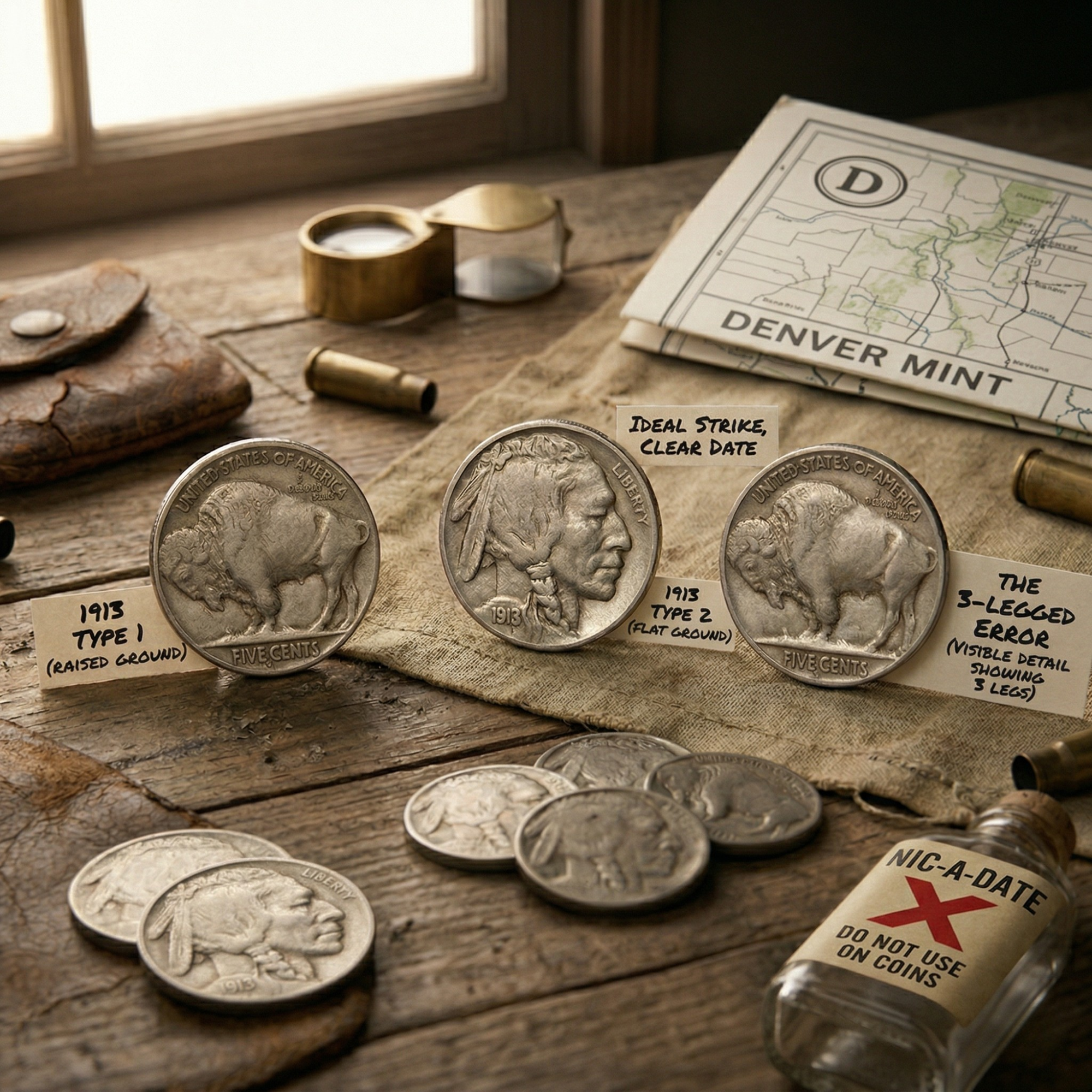
While Fraser’s design was an artistic triumph, it was an immediate mechanical failure for the US Mint. The coin’s relief was too high, making it difficult to strike properly. More importantly, the date was placed on the highest point of the coin—right on the shoulder of the Native American. As the coin circulated in pockets and cash registers, the date was the very first thing to wear off. This is why you will often find “dateless” Buffalo Nickels in old jars of change. While these dateless coins are a fun piece of history, they generally hold no numismatic value beyond a few cents. (Note: While a chemical called “Nic-A-Date” can use acid to reveal worn-off dates, this permanently damages the coin and should never be used on potentially valuable pieces!)
Type 1 vs. Type 2: The Quick Fix
The Mint realized the design flaws almost immediately. In 1913, the very first year of production, the bison on the reverse was depicted standing on a raised mound of dirt. Because the words “FIVE CENTS” were stamped on this raised mound, they started wearing off instantly. Halfway through the year, the Mint redesigned the die, putting the bison on a flat line and recessing the denomination to protect it. For collectors, this created two distinct variations for the first year: the 1913 Type 1 (Raised Ground) and the 1913 Type 2 (Flat Ground).
The Legendary 3-Legged Buffalo
If you are hunting for Buffalo Nickels, there is one famous error you must know about: the 1937-D 3-Legged Buffalo. In 1937 at the Denver Mint, a press operator noticed a clash mark on one of the reverse dies. To fix it, he heavily polished the die to smooth it out. Unfortunately, he polished it a bit too aggressively, completely erasing the bison’s front right leg. Thousands of these three-legged nickels were released into circulation before the mistake was caught. Today, it is one of the most famous and highly sought-after error coins in American history, commanding a massive premium in any condition.
A Gateway to the Wild West
Because they were minted in high numbers, common-date Buffalo Nickels in circulated condition are incredibly affordable, making them a perfect starting point for new collectors. But for the advanced numismatist, finding fully struck, uncirculated examples—with the bison’s horn fully visible and the date crisp—is a thrilling and valuable challenge. The Buffalo Nickel isn’t just money; it is a pocket-sized monument to the American frontier.
Did You Find a Vintage Buffalo Nickel?
If you have a collection of Buffalo Nickels, look closely! You might have a rare 1913 Type 1, a hidden mint mark, or even the legendary 3-Legged error.
Contact Keywell Collectibles today for a professional appraisal of your vintage nickels and US currency.