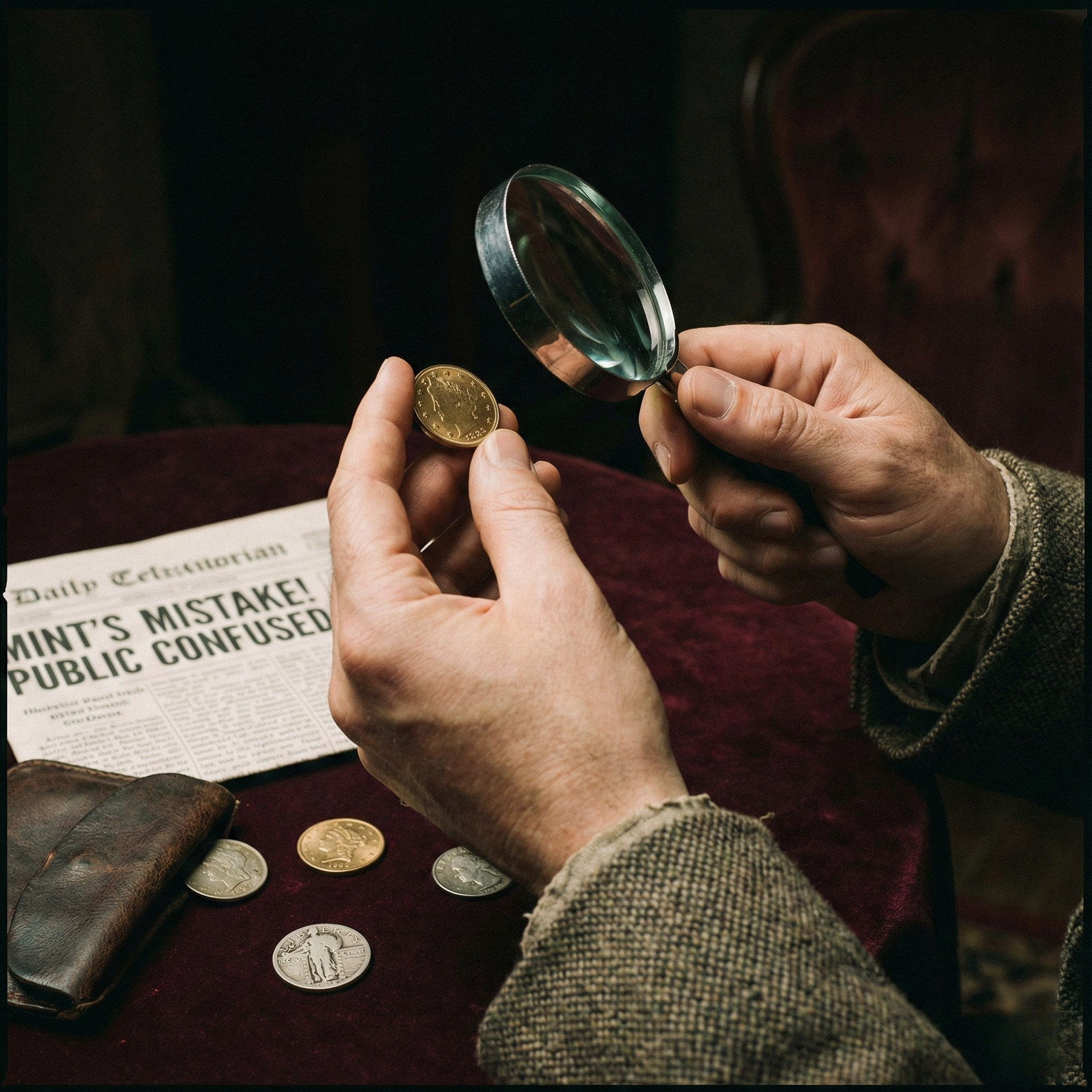
But history tells a different story.
Every once in a while, the Mint releases a coin that is a total disaster. Sometimes the design is controversial; sometimes it is confusing; and sometimes, it inadvertently helps criminals steal money.
For collectors, these “flops” are some of the most entertaining pieces to own. They represent the rare moments when the government tried something new, failed spectacularly, and had to scramble to fix it.
Here are the most famous design disasters in American history, and why you should add them to your collection.
The 20-Cent Piece (1875–1878): The Math Was Right, The Coin Was Wrong
In the 1870s, there was a shortage of small change in the West. People complained that because the smallest silver coin was a dime (10 cents), they couldn’t make proper change for items costing 12 cents or similar odd amounts.
The Mint’s solution? The 20-Cent Piece.
On paper, it made sense. In your hand, it was a nightmare.
The Mint decided to make the coin out of silver, just like the quarter. The problem was that 20 cents is very close to 25 cents. As a result, the 20-cent piece was almost the exact same size as the Quarter Dollar. To make matters worse, the reverse design featured an eagle that looked nearly identical to the eagle on the quarter.
The result was immediate confusion. People constantly mistook the 20-cent piece for a quarter, effectively losing 5 cents on every transaction. The public hated it, and the Mint killed the coin after just four years. Today, it is a quirky, scarce, and highly desirable collector’s item—a testament to the fact that logic doesn’t always translate to reality.
The “Racketeer Nickel” (1883): A Scammer’s Dream
In 1883, the Mint redesigned the nickel. The new “Liberty Head” nickel featured a large Roman numeral “V” on the back to signify 5 cents.
However, the designers made a critical omission: they forgot to write the word “Cents.”
Criminals immediately noticed a loophole. The new nickel was roughly the same size as the $5 Gold Half Eagle. Scammers began gold-plating the new nickels and passing them off as $5 gold coins. Since the coin had a big “V” on the back, they could claim it stood for “5 Dollars.”
This became known as the “Racketeer Nickel.”
The Mint panicked and halfway through 1883, they stopped production and added the word “CENTS” to the bottom of the design. Today, you can actually buy 1883 “No Cents” nickels that still have traces of the gold plating from 140 years ago—a souvenir of a 19th-century hustle.
The Standing Liberty Quarter (1916–1917): A Public Scandal
In 1916, the Mint released a beautiful new quarter designed by Hermon MacNeil. It featured a classical depiction of Lady Liberty standing guard in a gateway wall.
However, when the coins hit circulation, society societies and religious groups were scandalized. The design depicted Liberty with an exposed right breast.
While this style of “classical nudity” was common in French art and Greek statues, it was apparently too much for the American public in 1916. The Mint quietly ordered a redesign. In 1917, MacNeil added a coat of chainmail armor to Liberty’s chest to cover her up.
Collectors today categorize these coins as “Type 1” (exposed) and “Type 2” (covered). The Type 1 remains a highly sought-after key coin for its brief, controversial existence.
The Susan B. Anthony Dollar (1979–1981): The “Carter Quarter”
Fast forward to the modern era, and the Mint apparently forgot the lesson of the 20-cent piece.
In 1979, the government wanted to replace the large, heavy Eisenhower Dollar with a smaller, more efficient coin. They released the Susan B. Anthony (SBA) Dollar. It was the first time a real woman (not a mythological Liberty) appeared on a circulating US coin.
The intentions were good, but the execution was a disaster.
The coin was small, round, and silver-colored. It felt exactly like a quarter.
The public despised it. People would pay for a candy bar with what they thought was a quarter, only to realize later they had spent a dollar. It created frustration at toll booths, vending machines, and cash registers across the country. It was sarcastically dubbed the “Carter Quarter” (after President Jimmy Carter).
Production was halted in 1981. The Mint didn’t try a small dollar coin again until 2000, when they released the Sacagawea dollar—which they wisely made gold-colored and with a smooth edge to ensure no one confused it with a quarter.
Collecting the Mistakes
Why do we collect these failures? Because they humanize the hobby. They remind us that history isn’t just a list of dates and battles; it is also a series of bad ideas, public outcries, and quick fixes.
A collection of “Minting Disasters” makes for a fantastic display. It allows you to show someone a Racketeer Nickel and tell the story of the con artist, or hand them a 20-Cent piece and ask if they can tell the difference from a quarter.
These coins prove that sometimes, the “wrong” coin is the right one to buy.
Do You Have an Oddity in Your Collection?
Some of the most valuable coins in existence are valuable precisely because they were mistakes. Whether it is a design flop like the 1916 Quarter or a genuine mint error, we can help you understand what you have.