

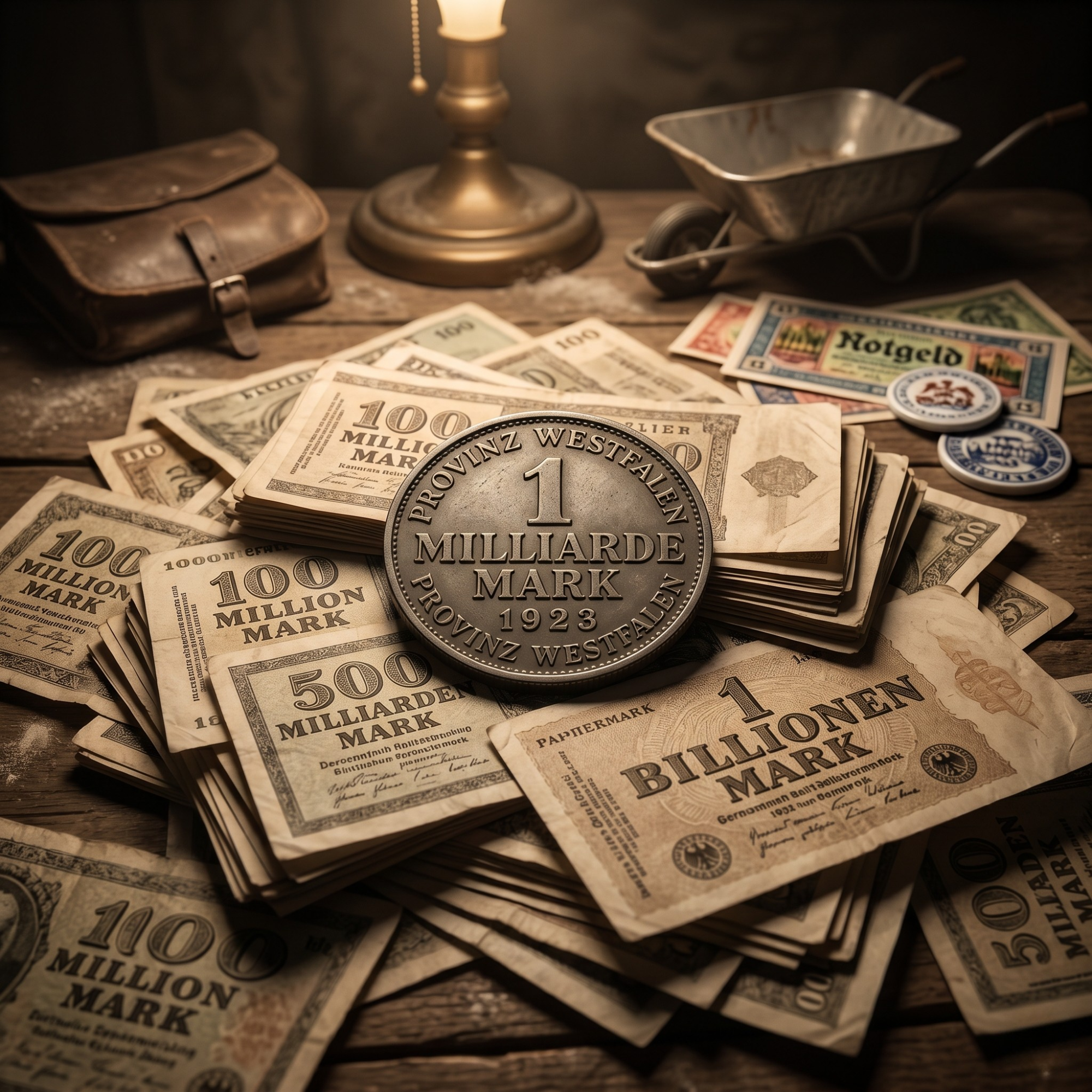
Billion-Dollar Bills: Hyperinflation and the Coins of the Weimar Republic
Imagine living in a world where you are paid twice a day, and you must sprint to the local bakery with a wheelbarrow full of cash before the price of bread doubles.
This wasn’t a dystopian novel; it was the harsh reality of the Weimar Republic in 1920s Germany, an economic disaster that produced some of the most mind-boggling coins and paper currency in human history.
When collectors think of valuable money, they usually think of gold, silver, or extreme rarity. But there is an entire subset of numismatics dedicated to the exact opposite: money that became so worthless, so incredibly fast, that the government had to print it in denominations of millions, billions, and even trillions. The currency of the Weimar Republic serves as a chilling, tangible reminder of what happens when a nation’s economy completely collapses.
The Weight of Versailles
The nightmare began at the end of World War I. The Treaty of Versailles forced a defeated Germany to pay massive financial reparations to the Allied powers. However, the treaty stipulated that these reparations could not be paid in Germany’s paper currency, the Papiermark, which was already losing value. They had to pay in gold or foreign currency.
To buy foreign currency, the German government simply turned on the printing presses and started printing paper marks around the clock. As the supply of paper money skyrocketed, its actual purchasing power plummeted. By 1923, the inflation had spiraled completely out of control into “hyperinflation.”
Notgeld: The Rise of Emergency Money
As the national currency collapsed and the central government failed to provide enough physical cash to keep up with skyrocketing prices, local municipalities, banks, and private businesses had to take matters into their own hands. They began issuing their own emergency money, known as Notgeld.
Notgeld is one of the most fascinating areas of foreign numismatics. Because metal was scarce after the war, towns got incredibly creative. They printed colorful paper bills featuring local folklore and satirical political cartoons. When paper ran out, they made coins out of whatever materials they could find. You can find authentic German Notgeld coins from this era made entirely out of aluminum, pressed coal, silk, leather, and even beautifully glazed porcelain!
The Billion-Mark Coin
As 1923 progressed, the central bank was printing money so fast that they couldn’t even design new bills; they simply took old bills and stamped new, massive denominations over the top of them.
The coinage also reflected this madness. The province of Westphalia issued some of the most famous hyperinflation coins in the world. In a desperate attempt to create a coin that actually had purchasing power, they minted the legendary 1 Billion Mark coin (1,000,000,000 Mark) in 1923. It was struck in an inexpensive base metal alloy, but the sheer absurdity of holding a single coin stamped with the word “Milliarde” (the German word for billion) makes it an absolute must-have for historical collectors today.
The Wheelbarrow Economy
At the peak of the crisis in November 1923, the exchange rate reached a staggering 4.2 trillion German marks to one single US dollar.
A loaf of bread that cost 250 marks in January cost 200,000 million marks by November. People literally used wheelbarrows to carry their paper money to the store. Children played with stacks of worthless cash like building blocks in the streets. People burned millions of marks in their fireplaces because the paper money was actually cheaper than buying firewood. The life savings of the entire German middle class were wiped out in a matter of months.
A Chilling Numismatic Warning
Eventually, the madness was stopped late in 1923 with the introduction of a new, stable currency called the Rentenmark, which was backed by real estate and industrial land. The old, trillions of paper marks were exchanged at a rate of one trillion to one.
Today, collectors eagerly buy Weimar Republic inflation money and Notgeld. Not because it contains precious metals, but because it is the ultimate economic cautionary tale. It is physical proof that a nation’s currency is only as strong as the public’s faith in it.
Do You Have Vintage Foreign Currency?
From German Notgeld to hyperinflation paper money, foreign currency holds incredible historical value and unique collector demand. If you have inherited albums of foreign money, don’t assume it’s just “worthless paper.”
Contact Keywell Collectibles today for a professional, accurate appraisal of your international coins and vintage paper currency.