

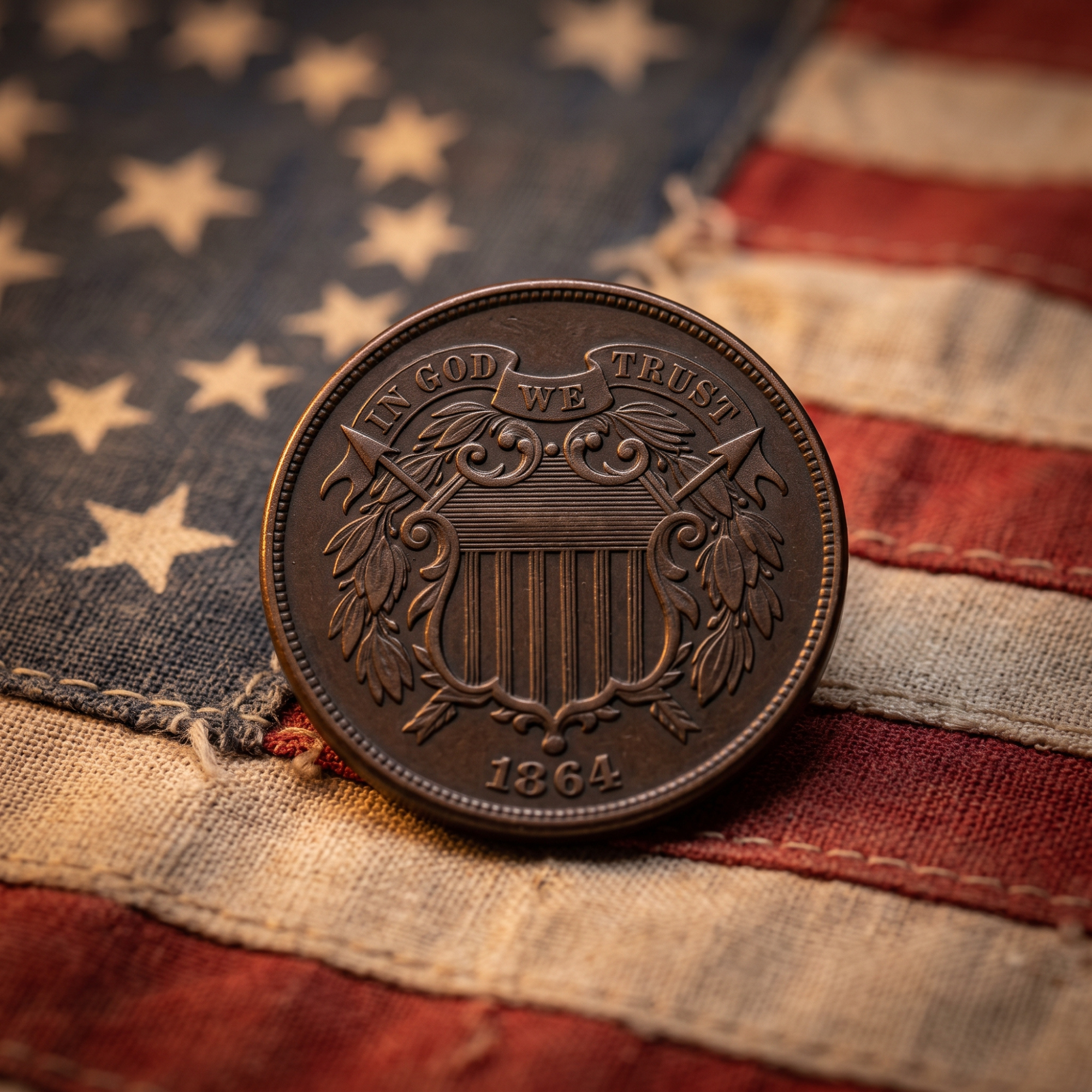
The Two-Cent Piece: The Coin That Gave Us “In God We Trust”
While most Americans assume the motto “In God We Trust” has been stamped on our money since the founding of the nation, its origins are actually rooted in the darkest, most divisive days of the American Civil War.
Struck for less than a decade, the odd and short-lived two-cent piece was born out of an extreme national coin shortage and forever changed the design of United States currency.
If you look at any modern coin in your pocket—a penny, a quarter, or a half dollar—you will find the phrase “In God We Trust.” It feels like a permanent, foundational piece of American identity. But for the first seventy years of the United States Mint’s history, the phrase was nowhere to be found.
It took the trauma of the Civil War, a massive economic crisis, and the introduction of a brand-new, peculiar copper denomination to finally bring those four words to the American public. Here is the fascinating story of the US two-cent piece.
The Civil War Coin Hoarding Crisis
When the American Civil War erupted in 1861, widespread panic swept through the Union. Citizens were terrified that the federal government might collapse, taking the value of paper money down with it. In response, people began aggressively hoarding anything of intrinsic, metallic value.
First, gold and silver coins vanished from circulation overnight. Then, as the panic deepened, citizens started hoarding the copper-nickel Flying Eagle and Indian Head cents. By 1862, federal coins had virtually disappeared from daily commerce. To buy groceries or a newspaper, citizens were forced to use fragile postage stamps, private merchant tokens (known as Civil War Tokens), or easily counterfeited fractional paper money. The economy was grinding to a halt.
The Birth of a New Denomination
To solve the crisis, the US Mint realized they needed to introduce coins made of a cheaper metal that citizens wouldn’t bother hoarding, but in a size that still felt substantial in the hand. The solution was the Coinage Act of 1864, which changed the composition of the penny to a lighter bronze alloy and introduced an entirely new denomination: the bronze two-cent piece.
Designed by Chief Engraver James B. Longacre, the two-cent piece was a large, heavy copper coin. The obverse (front) featured a prominent Union shield flanked by olive branches and arrows. The reverse simply featured a wheat wreath encircling the words “2 CENTS.” It was exactly what the public needed—a sturdy, functional coin to facilitate small change.
“In God We Trust” Makes Its Debut
The introduction of this new coin coincided perfectly with a religious movement sweeping the war-torn North. In late 1861, a Pennsylvania minister named Reverend M.R. Watkinson wrote a passionate letter to Treasury Secretary Salmon P. Chase. Watkinson argued that the nation needed to recognize the “Almighty God in some form on our coins” to declare the Union’s divine backing during the brutal conflict.
Secretary Chase agreed. He instructed Mint Director James Pollock to prepare a motto. After testing a few variations like “Our Trust Is In God” and “God Our Trust,” they finally settled on the iconic phrase we know today.
Because the newly authorized 1864 two-cent piece was the very next coin scheduled for production, it became the canvas for this historical first. A flowing ribbon was added above the shield on Longacre’s design, and the two-cent piece officially became the very first United States coin to bear the motto “In God We Trust.”
The “Small Motto” vs. “Large Motto” Rarity
For numismatists, the inaugural 1864 two-cent piece holds a fantastic challenge. When the Mint first began striking the coins, the letters on the motto ribbon were quite small and visually cramped. Recognizing the issue, the engravers quickly altered the steel die, making the lettering thicker and more pronounced for the remainder of the year.
This created two distinct varieties for the 1864 issue: the “Small Motto” and the “Large Motto.” Because the Small Motto was only struck for a very brief period at the beginning of production, it is significantly rarer. A heavily worn Large Motto 1864 two-cent piece might be worth $20, while a Small Motto in the exact same condition can easily command hundreds of dollars.
A Short-Lived Legacy
The two-cent piece was a massive initial success, with nearly 20 million struck in its first year. However, as the Civil War ended and the coin shortage subsided, the public’s enthusiasm waned. The government soon introduced the copper-nickel three-cent piece and the five-cent Shield Nickel, making the heavy two-cent piece redundant.
Mintage numbers plummeted every year until Congress finally abolished the denomination in 1873. Though its lifespan was incredibly short, the two-cent piece left an indelible mark on American history. The motto it introduced was eventually mandated on all US coinage, making this odd, obsolete copper coin the godfather of modern American currency design.
Do You Have Obsolete US Coins?
Odd denominations like two-cent pieces, three-cent silvers, and half dimes are common finds in old estate collections, but evaluating their varieties (like the 1864 Small Motto) requires an expert eye.
Contact Keywell Collectibles today for a professional, secure appraisal of your vintage United States coins and family heirlooms.