

The Educational Series of 1896: America’s Most Beautiful Paper Money
In the late 19th century, the United States government decided that its paper currency shouldn’t just be functional; it should be a soaring, artistic masterpiece.
The result was the 1896 Educational Series, a set of three silver certificates that completely abandoned traditional design rules and created what many collectors consider to be the most beautiful currency ever printed.
If you pull a modern dollar bill out of your wallet, it looks like, well, money. It has a portrait of a dead president in the center, a lot of intricate green and black geometric patterns (called lathework), and prominent numbers in the corners. It is utilitarian and highly functional.
But in the 1890s, the Bureau of Engraving and Printing (BEP) decided to treat a banknote like a canvas. They commissioned world-class muralists and painters who had studied in Paris to design a new series of silver certificates. Instead of a simple portrait, these artists created sweeping, edge-to-edge allegorical murals. The stunning series of 1896 included a $1, $2, and $5 note, known collectively today by numismatists as the “Educational Series.”
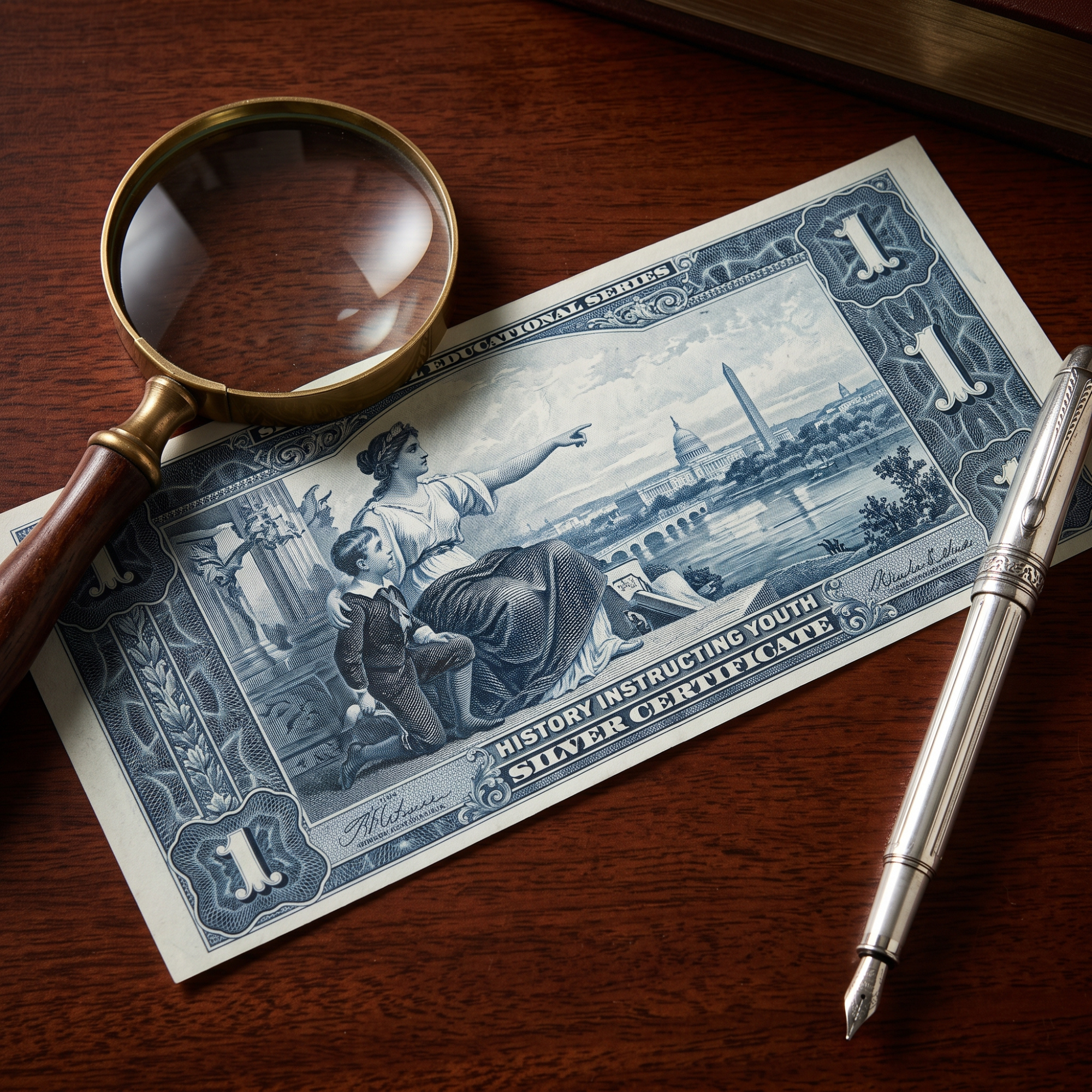
The $1 Note: History Instructing Youth
Designed by Will Hicok Low, the front of the $1 silver certificate looks like a painting you would find on the ceiling of the Library of Congress.
The sprawling vignette is titled “History Instructing Youth.” It features a female personification of History teaching a young boy. With her arm extended, she points across a panoramic view of the Potomac River toward Washington, D.C., where the Capitol building and the newly completed Washington Monument can be seen in the distance. The United States Constitution rests open on the right side of the note, and the border is encircled by the names of famous Americans.
The reverse of the $1 note is equally historic, featuring the portraits of both George and Martha Washington. To this day, Martha Washington remains the only woman whose portrait has ever appeared as the primary central vignette on United States federal paper money.
The $2 Note: Science and Industry
The $2 note, designed by Edwin H. Blashfield, took the artistic vision even further. The central mural is titled “Science Presenting Steam and Electricity to Commerce and Manufacture.”
The design features five allegorical female figures and children representing the massive technological leaps of the late 19th century. In the center, Science presents two children to the adult figures of Commerce and Manufacture. One child holds a windpipe (representing the power of steam), while the other holds a galvanic coil (representing the new, magical power of electricity).
On the back of the note, honoring the theme of technological progress, the BEP placed the portraits of Robert Fulton (the inventor of the commercial steamboat) and Samuel F.B. Morse (the inventor of the telegraph).
The $5 Note: The “Banned in Boston” Controversy
The crown jewel of the Educational Series is the $5 note, designed by Walter Shirlaw. Its sweeping mural is titled “Electricity as the Dominant Force in the World.”
It features a stunning, winged female figure representing Electricity. She stands upon a globe, holding a radiant lightbulb aloft, surrounded by the chariot of Jupiter and galloping horses. While collectors today view it as an absolute triumph of classical engraving, the conservative public of 1896 had a very different reaction.
Following the traditions of classical Greek and Roman art, the female figure representing Electricity was drawn with her chest exposed. When the bills hit circulation, it caused an immediate social uproar. Several prominent Boston society ladies reportedly took immense offense to the “indelicate” design, and conservative bankers refused to hand the bills out to customers. This controversy led to a popular numismatic legend that the $5 Educational Note was actually “banned in Boston.”
A Beautiful Failure
Despite their breathtaking beauty, the Educational Series was a complete practical failure.
Because the sweeping murals took up the entire front of the bill, the artists removed the complex, machine-engraved lathework that traditionally protected bills from counterfeiters. Furthermore, the denominations were small and hard to read, making life miserable for bank tellers trying to count the money quickly. Finally, the intricate, dark ink on the back of the bills smudged easily when the paper got dirty in circulation.
Bowing to public complaints and the frustration of bankers, the government abandoned the beautiful experiment almost immediately. The Educational Series was replaced just three years later by the much more traditional Series of 1899.
Today, because they were printed for such a short window of time, surviving 1896 Educational notes are highly prized by currency collectors. Finding all three notes in crisp, uncirculated condition is the ultimate achievement for any enthusiast of American paper money.
Do You Have Vintage Large-Size Currency?
Prior to 1928, United States paper money was physically much larger than the bills we use today. These “horse blankets” often feature incredible artwork and significant numismatic premiums.
Contact Keywell Collectibles today for a professional appraisal of your vintage paper money and obsolete currency.