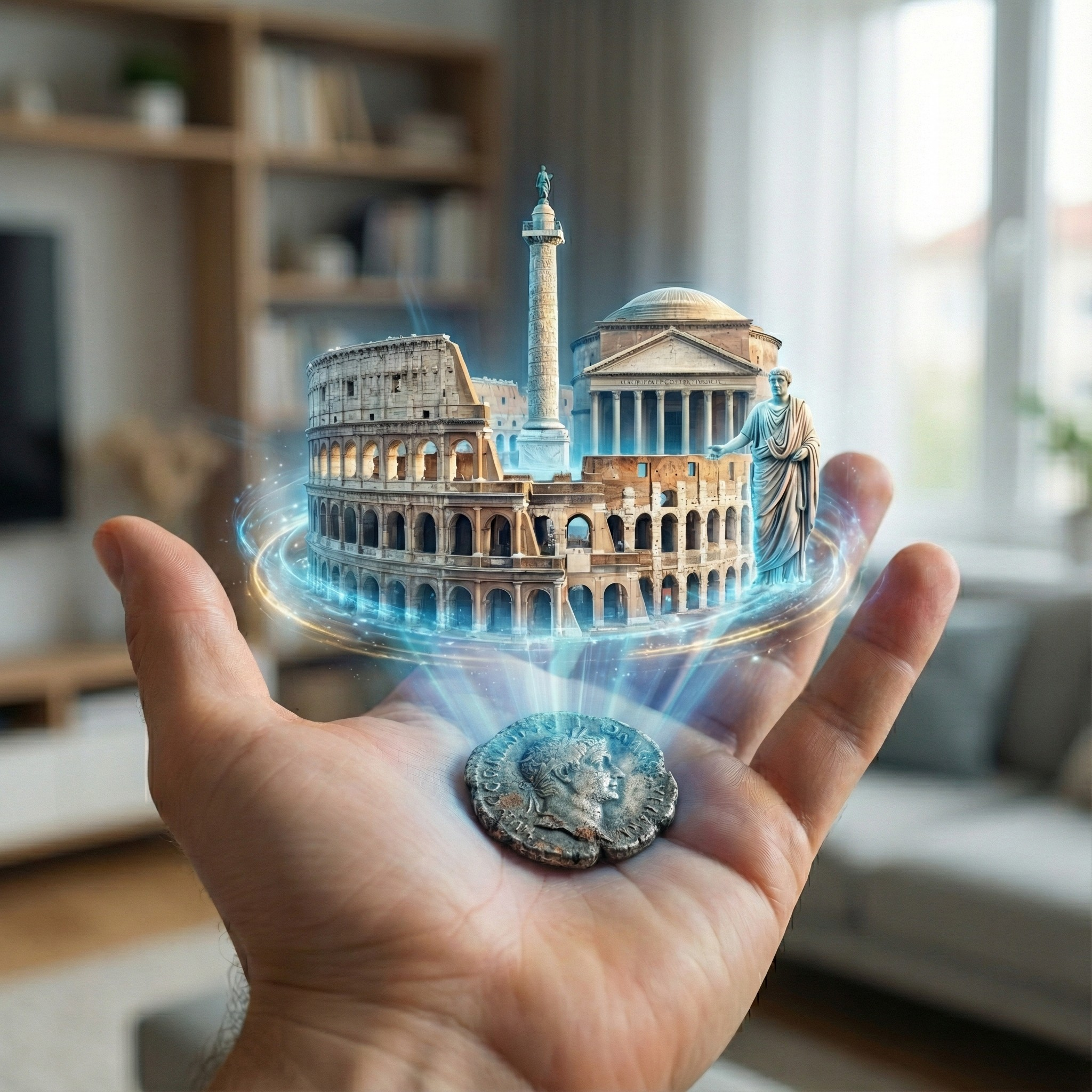
When you hold a silver Denarius from the Roman Empire or a copper drachm from Ancient Greece, you aren’t just holding currency; you are holding a physical time machine.
Who held this coin before you? Was it paid to a Roman legionary stationed in Britain? Did it buy a loaf of bread in the markets of Athens? Was it dropped by a merchant traveling the Silk Road?
For many collectors, the world of ancient coins feels intimidating. We tend to assume that anything from the time of Julius Caesar or Alexander the Great must belong in a museum, behind thick glass, with a price tag in the millions.
Here is the best-kept secret in numismatics: You can build a museum-quality collection of ancient history for less than the cost of a modern commemorative set.
If you have ever wanted to own a piece of antiquity, this guide is your entry point into the fascinating “Dark Side” of coin collecting.
The Myth of the Million-Dollar Coin
Let’s tackle the biggest misconception first. Yes, there are ancient coins that sell for millions. The “Eid Mar” Denarius (minted by Brutus to celebrate the assassination of Julius Caesar) is a prime example. But these are the exceptions, not the rule.
The reality is that the ancient world operated on a massive scale. The Roman Empire, for instance, spanned three continents and lasted for centuries. They minted billions of coins to pay their armies and facilitate trade. Because these coins were made of durable metal and often buried in clay pots (hoards) for safekeeping during turbulent times, millions of them have survived to the present day.
This supply means that you can purchase a genuine, identifiable bronze coin featuring Constantine the Great (the first Christian Emperor) for roughly the price of a movie ticket and popcorn. A silver coin from the era of the “Five Good Emperors” might cost less than a new pair of sneakers.
Where to Start: The “Big Three” for Beginners
The world of ancients is vast, spanning roughly 600 BC to 1453 AD. To keep from getting overwhelmed, most new collectors start in one of three lanes.
1. The Roman Empire
This is the most popular entry point. The history is familiar, the emperors are famous, and the coins are abundant.
- What to look for: The Late Roman Bronze. These are small, durable coins from the 3rd and 4th centuries AD. They often feature intricate portraits of emperors wearing diadems or helmets.
- The Step Up: The Silver Denarius. This was the “dollar” of the Roman world. A Denarius of Emperor Trajan or Hadrian is a substantial, silver coin roughly the size of a dime but much thicker. It feels substantial in the hand and connects you directly to the height of the Empire’s power.
2. Ancient Greece
Greek coins are widely considered the most artistic coins ever produced. They were treated as high art, often minted in high relief with stunning mythological designs.
- What to look for: While the famous “Owl of Athena” (the large silver Tetradrachm) is pricey, you can find smaller denominations (Drachms or Obols) featuring Alexander the Great dressed as Hercules, or coins featuring Pegasus, the winged horse. These offer incredible artistry at a more accessible price point.
3. Biblical Coins
For many, the draw is religious history. Collecting coins that circulated in the Holy Land during specific historical periods provides a tangible connection to scripture.
- What to look for: The Widow’s Mite (Prutah). These are small, roughly made bronze coins that circulated in Judea during the 1st century BC and 1st Century AD. While they aren’t the prettiest coins, their historical and cultural significance makes them a favorite for many collectors.
Forget “Mint State”—Look for “Eye Appeal”
If you are coming from the world of modern US coins, you need to rewire your brain regarding grading. In modern collecting, the difference between a grade of 69 and 70 can mean thousands of dollars.
In ancient coins, we don’t obsess over numeric perfection in the same way. Instead, we look for three things:
- Strike: These coins were hand-hammered between two dies. Sometimes the worker missed, and the image is off-center. A perfectly centered strike where you can see the full design and lettering is highly desirable.
- Surface: Has the coin been corroded by the ground it was buried in? A smooth surface is better than a pitted, porous one.
- Style: Because dies were hand-engraved, some engravers were simply better artists than others. You might see two coins of the same type, but one portrait looks realistic and noble, while the other looks cartoonish. The “fine style” coin is always worth more.
Don’t be afraid of a little wear. A coin that was circulated has a story. The smooth high points on a portrait of Marcus Aurelius are just evidence that the coin did its job.
The Danger Zone: Fakes and Provenance
The biggest risk in ancient coins is authenticity. Because these coins are irregular by nature, it can be harder for a novice to spot a counterfeit. “Tourist fakes”—coins sold to travelers at popular ruins or markets abroad—are rampant.
The golden rule of ancient collecting is: Buy the dealer, not the coin.
You should only acquire ancient coins from reputable numismatic firms that offer a lifetime guarantee of authenticity. At Keywell Collectibles, we stand behind every piece we assess. Additionally, provenance (the history of who owned the coin previously) is vital. A coin with a paper trail dating back to an old collection is always a safer bet than a raw coin from an unknown source online.
Handling Your History
Here is the best part: You can touch them.
Unlike a Proof 70 modern coin that loses half its value if your fingerprint touches the surface, ancient coins are tough. They have spent centuries in the ground and passed through thousands of hands. Washing your hands and holding a Roman Denarius by its edges to admire the weight and artistry is perfectly acceptable. It is part of the joy of ownership.
However, storage matters. Never store ancient coins in soft plastic flips that contain PVC (polyvinyl chloride). Over time, PVC breaks down and releases an acid that creates a green, sticky slime on the coin, ruining the surface. Always use rigid plastic flips or archival-quality holders.
A Collection That spans Millennia
Collecting ancient coins is an intellectual pursuit that never really ends. You might start with a single Roman coin, then decide you want one from each of the “Twelve Caesars,” or perhaps you’ll become fascinated by the animals depicted on Greek coinage.
Whatever path you choose, you are preserving a small, metallic piece of human civilization.
Do You Have History in Your Drawer?
Whether you are looking to start your journey into ancient numismatics, or you have inherited a collection of old world coins and don’t know if they are genuine artifacts or modern replicas, we can help.