
The Morgan Dollar’s Older Sister: Collecting Seated Liberty Silver
Long before the legendary Morgan Silver Dollar became the symbol of the American West, an elegant, classical design dominated the nation’s pockets.
From the late 1830s until 1891, the “Seated Liberty” design appeared on almost every silver coin in the United States, creating one of the most historically rich and challenging series for modern collectors.
When you think of vintage US silver, the Morgan Dollar usually steals the spotlight. However, the Morgan Dollar wasn’t introduced until 1878. If you were a soldier fighting in the Civil War, a pioneer heading west on the Oregon Trail, or a prospector in the California Gold Rush, you weren’t spending Morgan Dollars. You were spending Seated Liberty silver.
Designed by Christian Gobrecht, the Seated Liberty design was the backbone of American commerce for over half a century. Understanding its history and its many variations is a rite of passage for any serious numismatist.
A Unifying Artistic Vision
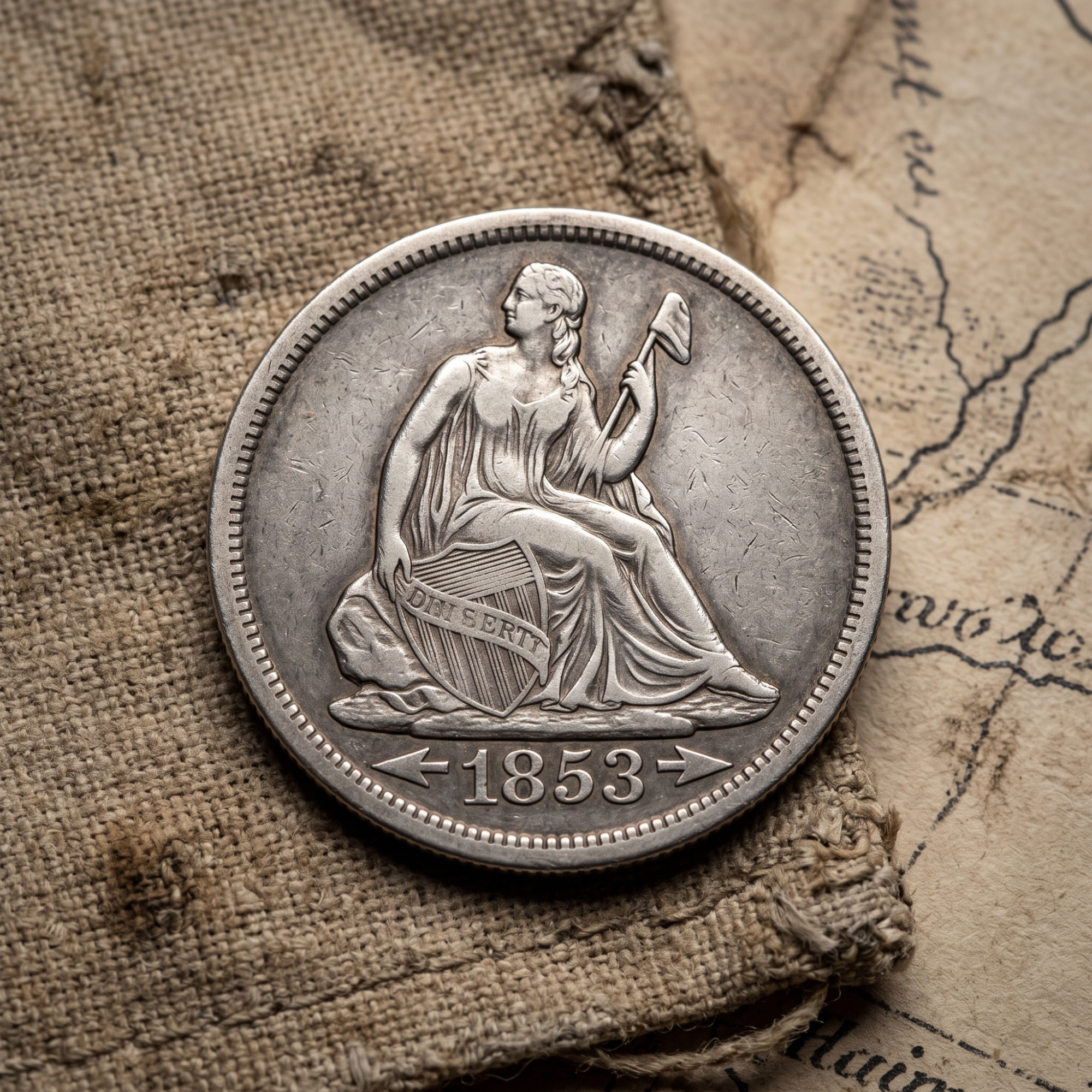
In the late 1830s, the US Mint decided to unify the look of its silver coinage. Gobrecht’s design was highly classical and heavily inspired by British Britannia coins. It featured Lady Liberty seated gracefully on a rock. In her left hand, she holds a pole with a Phrygian cap (a traditional symbol of freedom), and her right hand rests upon a Union shield inscribed with the word “LIBERTY.”
This singular, elegant design was stamped onto almost every silver denomination the Mint produced. It was used on the tiny silver half dime, the dime, the quarter, the half dollar, and the massive silver dollar. For collectors today, this means you can build a fascinating “Type Set” by collecting one of each denomination, all featuring the exact same artwork.
The “Arrows at Date” Varieties
The most fascinating aspect of collecting Seated Liberty silver is the physical evidence of economic chaos stamped right onto the coins.
In 1848, gold was discovered in California. As massive amounts of gold flooded the market, the price of silver skyrocketed in comparison. Suddenly, the silver contained inside a Seated Liberty quarter was actually worth more than 25 cents. As a result, the public began hoarding and melting down all the silver coins they could find, causing a massive national coin shortage.
To stop the hoarding, the Mint was forced to secretly reduce the physical weight of all silver coins in 1853. To let banks and merchants know that these new coins were lighter than the old ones, the Mint placed prominent arrows next to the date and added rays of sunlight on the back of the quarters and half dollars. These “Arrows and Rays” and “Arrows at Date” varieties (minted primarily between 1853 and 1855) are huge favorites among collectors because they vividly tell the economic story of the California Gold Rush.
Two decades later, in 1873, the Mint slightly increased the weight of the coins to match international metric standards, again adding arrows next to the date for a brief two-year period (1873–1874) to signify the change.
A Numismatic Challenge
Because the Seated Liberty series ran for so long (from 1836 to 1891), it is full of incredible rarities, design tweaks, and historical mint marks.
You can find coins struck at the legendary, short-lived Carson City (“CC”) Mint in Nevada, or coins struck at the New Orleans (“O”) Mint right before it was seized by the Confederacy. There are varieties where Liberty has no drapery on her elbow, and later versions where the motto “In God We Trust” was finally added above the eagle.
The Transition to Modern Coinage
In 1892, the aging Seated Liberty design was finally retired across all denominations and replaced by the much more static, conservative “Barber” coinage.
While heavily worn Seated Liberty dimes and quarters are relatively affordable and make great entry points for new collectors, high-grade, uncirculated specimens are incredibly rare. Because these coins were the workhorses of the 19th-century American economy, finding one that survived without heavy wear or harsh cleaning is a major numismatic victory.
Discover Vintage 19th-Century Silver
Because of the massive amount of varieties, overdates, and altered weights, evaluating Seated Liberty coinage requires a trained numismatic eye. Do you have an 1853 “Arrows and Rays” quarter, or perhaps a rare Carson City half dollar?
Contact Keywell Collectibles today for a professional, accurate appraisal of your vintage silver coins and estate hoards.