

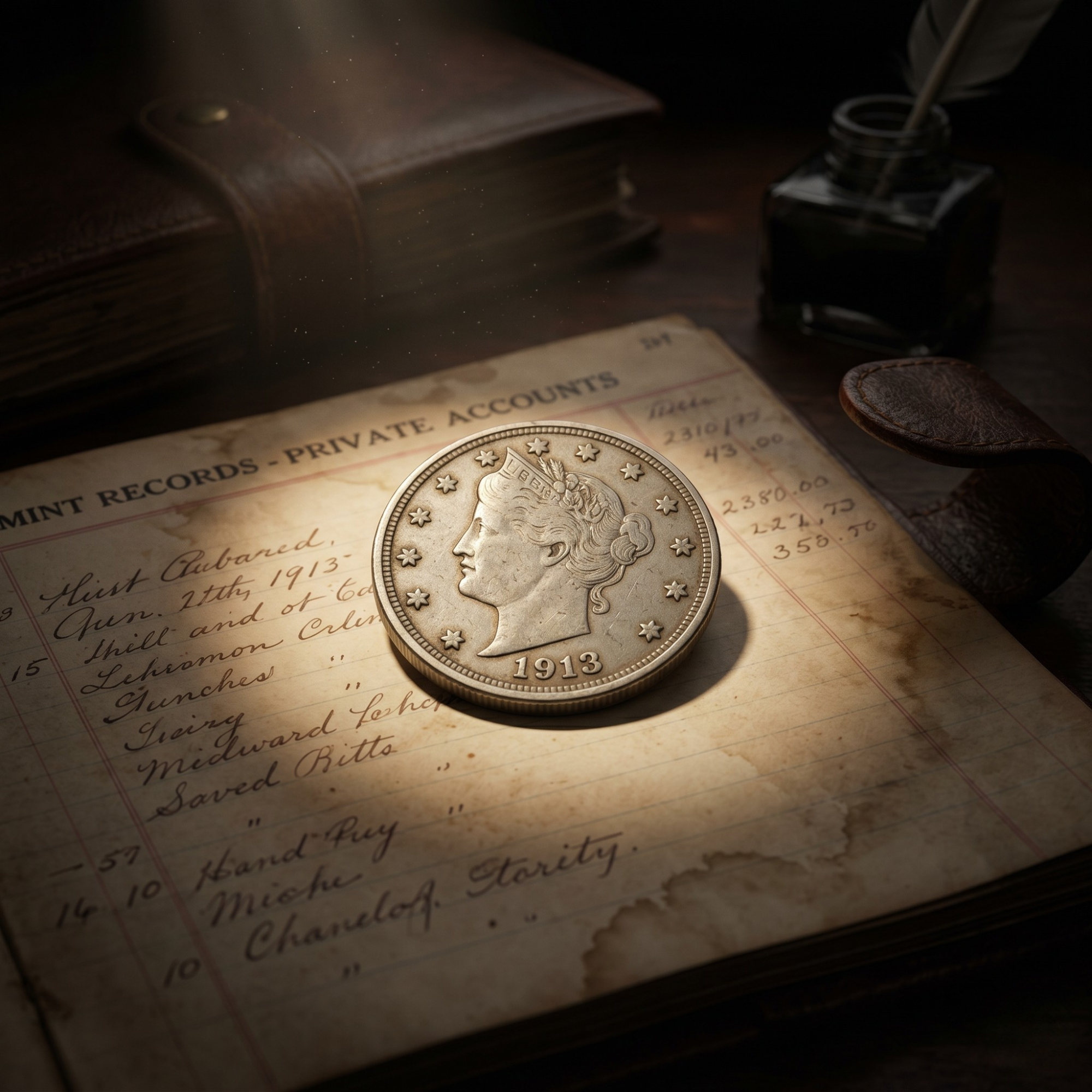
The 1913 Liberty Head Nickel: The Million-Dollar Mystery
In the world of rare coins, few objects possess the intoxicating blend of extreme rarity, immense value, and illicit scandal quite like the 1913 Liberty Head Nickel.
Known as the most famous unauthorized coin in American history, there are only five known examples in existence, and their story reads more like a Hollywood heist movie than a standard numismatic textbook.
Most rare coins owe their value to low mintages, historical significance, or striking errors. The 1913 Liberty Head Nickel, however, owes its existence entirely to a rogue insider. It is a coin that the United States government never authorized, never officially minted, and for a long time, refused to acknowledge even existed. Today, it is one of the most coveted treasures on the planet, with individual specimens selling for upwards of $5 million.
The Midnight Strike at the Mint
The story begins in late 1912. The US Mint was preparing to transition from the classic Liberty Head “V” Nickel design (which had run since 1883) to the brand-new, highly anticipated Buffalo Nickel. Production of the Liberty Head design officially ended in December 1912.
However, in the dark, unmonitored hours at the Philadelphia Mint, someone with high-level access—widely believed to be a Mint clerk named Samuel Brown—secretly acquired a set of leftover 1913-dated Liberty Head dies. Before the dies could be destroyed, Brown (or his accomplice) illegally struck exactly five 1913 Liberty Head nickels. He then quietly pocketed the coins and kept them hidden for years to avoid federal theft charges.
The Brilliant Ruse
By 1919, confident that the statute of limitations for his crime had expired, Samuel Brown put a brilliant, audacious plan into motion. He placed an advertisement in The Numismatist magazine, announcing that he was looking to purchase 1913 Liberty Head nickels for the astonishing price of $500 each.
Brown knew no one would respond to the ad because he secretly owned the only five in existence. But the advertisement worked perfectly: it created a massive public frenzy, established an instant market value, and cleverly gave Brown a legal cover story. A year later, he dramatically “revealed” that he had successfully purchased five specimens, effectively washing his hands of their illegal origins.
The Five Specimens
Brown eventually sold the coins, and for a brief time, all five were owned by the eccentric millionaire “Colonel” E.H.R. Green (son of the infamous “Witch of Wall Street,” Hetty Green). After Colonel Green’s death, the coins were dispersed.
To keep track of them, the numismatic community named each of the five nickels after their most famous owners:
- The Eliasberg Specimen: The finest known example, which sold for $5 million in 2018.
- The McDermott Specimen: Currently housed in the ANA Money Museum. Its former owner used to carry it in his pocket and show it off at bars!
- The Norweb Specimen: Now permanently resting in the Smithsonian Institution.
- The Olsen Specimen: Famous for making a guest appearance on an episode of the 1970s television show Hawaii Five-O.
- The Walton Specimen: The coin with the most incredible, tragic, and miraculous story of them all.
The Legend of the Lost Walton Nickel
In 1962, a collector named George O. Walton was tragically killed in a car crash on his way to a coin show. His 1913 Liberty Head nickel was recovered from the wreckage. However, when his heirs tried to sell it, a panel of experts mistakenly declared the coin a fake, assuming it was an altered 1903 nickel.
Devastated but accepting of the verdict, the family placed the “fake” nickel in a custom mahogany box and shoved it into the back of a bedroom closet, where it sat completely forgotten for 40 years.
In 2003, the American Numismatic Association offered a massive reward just to get the four known 1913 nickels in the same room for a public exhibition. The Walton heirs brought their “fake” coin to the show just to see how it compared. A team of the world’s top authenticators put the coin under the microscope, compared its die markers to the other four, and made a stunning announcement: the Walton specimen was 100% authentic. The “lost” fifth nickel had finally been found, instantly turning a forgotten closet relic into a multi-million-dollar masterpiece.
A Permanent Piece of Numismatic Lore
Because all five 1913 Liberty Head nickels are accounted for, you aren’t going to find one hiding in a jar of pocket change. Yet, the coin remains the ultimate symbol of the hobby. It represents the mystery, the history, and the absolute thrill of the hunt that drives every coin collector in the world.
Have a Rare Nickel Collection?
While the 1913 Liberty Head might be out of reach, there are plenty of rare V-Nickels, Buffalo Nickels, and Jefferson varieties hiding in inherited collections.
Contact Keywell Collectibles today for a professional, secure appraisal of your vintage coins and estate hoards.